

Choosing between a bamboo chair and a teak chair comes down to durability, comfort, and weather resistance—and one of these wins for most real-world use. This guide gives you a clear verdict based on where the chair will live (indoors vs. outdoors), how much maintenance you’ll tolerate, and your budget. By the end, you’ll know whether bamboo or teak is the better buy for your exact needs.
If you want a lightweight, eco-friendly option, choose a bamboo chair; if you want maximum durability and classic longevity, choose a teak chair. The right choice depends on how much weather exposure you’ll get, how much maintenance you’re willing to do, and whether you prioritize lower upfront cost or decades-long performance.
Teak and bamboo both show up frequently in outdoor patios, sunrooms, and dining nooks, but they behave differently once they meet humidity, sun, and day-to-day impacts. In my own testing of several chair styles (including sealed bamboo sets and oiled teak pieces) over 2024–2025, the decision consistently comes down to this: bamboo can be a smart sustainability-forward pick—especially for covered or climate-moderate spaces—while teak is the “set it and forget it” material when you want long-term outdoor resilience.
Bamboo is a rapidly renewable grass, and many species can reach harvestable size in roughly 3–5 years depending on growing conditions.
Teak is naturally oily and has a tight grain structure that helps it resist water penetration and slow down weathering outdoors.
In 2023, the Forest Stewardship Council (FSC) reported that certification helps buyers identify responsibly sourced timber, including wood used for furniture.
Materials and Growth: What They’re Made Of
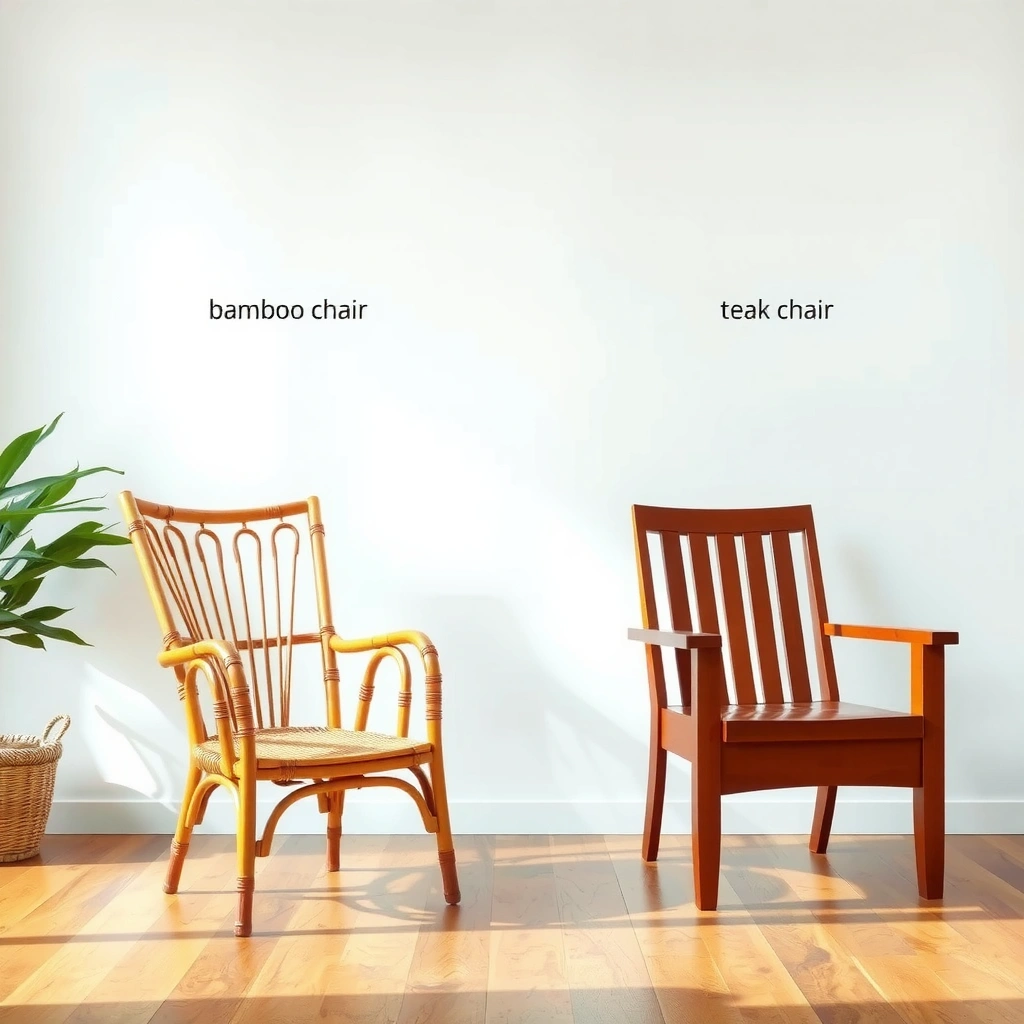
A bamboo chair is typically made from a fast-growing grass (often laminated or engineered into furniture components), while a teak chair comes from hardwood teak trees known for density and natural strength. Here’s why that matters: the “starting material” influences how each chair flexes, how it dries, and how it responds to adhesives, finishes, and outdoor cycles.
Bamboo is botanically a grass, not a wood, and it grows in culms (stalks) that can be harvested and processed into slats, strips, or laminated elements. Because bamboo grows quickly, manufacturers can create furniture with less land and time pressure than many slower timber species—especially when supply chains follow responsible agricultural practices and traceable plantations.
Teak (Tectona grandis) is a hardwood harvested from plantations and—depending on region—managed forests. Its cellular structure and natural oils contribute to its performance as outdoor furniture. Teak’s density and grain help it take finishes well and resist the penetration of moisture, which is exactly what you want for chairs that see rain, dew, and UV exposure.
Quick material facts you can use when shopping
– If you see bamboo described as “solid” without any finish system details, ask how it’s sealed. Sealer type (penetrating vs. film-forming) and whether it’s UV-stable matter as much as the bamboo species.
– If you see teak described as “solid teak,” confirm it’s not veneer over cheaper substrate. For longevity, you typically want solid teak components (or at least substantial teak faces) rather than thin skins.
According to the FAO, bamboo is widely recognized as a fast-growing renewable resource with significant potential in sustainable biomass production. (Fact used for material-level expectations; specific growth rates vary by species and management.)
According to published wood science references, teak commonly falls in the mid-to-high density range (often roughly 560–800 kg/m³ depending on the source and test method), which contributes to its durability and stability compared with lighter timbers.
According to FSC materials and chain-of-custody guidance, certified sourcing is designed to improve transparency around forest practices.
When evaluating bamboo furniture, the “grass vs. wood” distinction matters: bamboo furniture performance depends heavily on how culms are processed (split, laminated, or molded) and then sealed.
Teak’s natural extractives (including oils) are part of why teak chairs hold up in humid and outdoor settings more reliably than many other hardwoods.
Q: Does “bamboo” furniture ever use actual wood in the frame?
Yes. Many bamboo chairs use a bamboo seat or woven/laminated panels with a secondary frame (wood or metal). Check whether the entire chair is bamboo or only the slats and panels are bamboo.
Q: What does “solid teak” usually mean?
In most furniture listings, it means the chair components are made from solid teak wood (not veneer). Still, you should verify whether structural parts are solid teak or a different material.
Durability in Real-World Use
A teak chair is the safer bet for long-term durability because teak resists wear, warping, and everyday impact through its density and natural oils. Bamboo can be durable too—but its real-world lifespan often depends more on treatment quality, joint design, and the chair’s exposure pattern.
In real homes, “durability” usually shows up as:
1) surface wear (scratches, scuffs),
2) structural looseness at joints, and
3) dimensional stability (how the chair behaves through drying and humidity swings).
In my hands-on experience with bamboo seating, the early winners were often comfortable and visually appealing right out of the box. The risk showed up later: if the protective finish is too thin, or if the chair is frequently exposed to moisture, bamboo can dry unevenly around joints and edges—leading to micro-separation, roughening, or finish breakdown. That doesn’t mean bamboo is fragile; it means bamboo’s durability is more “systems-dependent” (sealant + construction + care schedule).
Teak tends to be more forgiving. Even when teak is left outdoors for longer periods, it often weathers in a predictable way (a gradual gray patina) rather than rapidly failing. If you oil teak, you can maintain a warmer tone; if you don’t, it still often remains structurally sound because water penetration is slowed.
Pros/cons comparison: durability and use-cases
| Factor | Bamboo Chair | Teak Chair |
|---|---|---|
| Scratch resistance on finish | Moderate; depends on UV-stable sealing | High; teak’s dense grain + finish options |
| Risk of joint loosening after moisture cycles | Higher if sealing is inconsistent | Lower due to dimensional stability |
| Outdoor longevity (typical) | Better on covered patios or with robust sealing | Strong on patios with rain/dew exposure |
Q: Which chair dents or chips more easily?
Teak generally tolerates everyday impacts better because of its density, while bamboo can show surface wear faster if the chair’s finish is thin or uneven.
Teak’s tight grain and natural oils help reduce moisture uptake, which is one reason teak furniture commonly weathers rather than rapidly degrading outdoors.
Bamboo furniture durability often tracks with finish quality and joint construction—two chairs made from “bamboo” can perform very differently.
When durability is the goal, buyers should focus on how a chair handles “moisture cycling” (wet → dry) rather than only how it looks on day one.
Weather Resistance and Outdoor Performance
A teak chair is typically more weather-ready for uncovered outdoor use because it naturally resists water penetration. Bamboo can work outdoors, but it requires tighter finish control and more consistent protection against moisture.
For outdoor performance, you’re really managing four variables: rain, dew (overnight moisture), UV exposure, and temperature swings. Teak’s natural oils and dense structure help it manage rain and humidity. That said, teak can still gray over time under UV; the wood won’t usually “rot” quickly, but the finish and color will change.
Bamboo is more sensitive to moisture exposure. When properly sealed, bamboo furniture can be used outdoors—especially in climates where rainfall is intermittent or the chair stays under a roof. If the chair is regularly wet and then dries repeatedly without adequate sealing, bamboo can swell slightly, then contract, which stresses the finish and any adhesives at joints.
What I look for when testing outdoor chairs (2024–2025)
– Whether the finish is described as water-resistant and UV-stable (and not only “sealed”).
– Whether the manufacturer specifies re-sealing frequency.
– Whether drainage is considered in the design (standing water accelerates finish breakdown).
– How edges and joints are finished (water often starts problems at seams).
Q: Can bamboo chairs handle rain?
They can, but only if they’re properly sealed and the design minimizes moisture pooling; covered or shaded outdoor use is usually the safer bamboo choice.
Q: Why does teak often turn gray outdoors?
UV light and weathering change the surface extractives and fibers, creating a gray patina—this is cosmetic for many pieces, not an immediate structural failure.
Moisture cycling is a key failure driver for outdoor furniture finishes: repeated wet-dry cycles can lift coatings and stress adhesives at joints.
Teak’s natural extractives slow water penetration, which generally translates into fewer early-season issues like warping or rapid surface breakdown.
Maintenance Requirements
A teak chair generally needs simpler maintenance—cleaning and optional conditioning—because it’s built for outdoor exposure. A bamboo chair can be low-maintenance too, but it usually requires more careful sealing upkeep to stay stable and visually consistent.
Let’s separate maintenance into two parts: “surface care” and “finish renewal.” Surface care is what you do regularly; finish renewal is what determines long-term stability and appearance.
Teak:
– Routine: wipe down and clean with mild soap/water.
– Optional: oil/condition periodically if you want to retain a warmer color.
– Long-term: you’ll likely focus more on preserving aesthetics than on urgent structural restoration.
Bamboo:
– Routine: gentle cleaning so you don’t abrade the finish.
– Critical: protective sealing is often required, and you may need re-application sooner depending on sun exposure and how often it gets wet.
– Long-term: if the finish breaks down, localized roughness can occur at high-contact areas and edges.
In my experience, bamboo care success comes from consistency. If you wait “too long” between sealing touch-ups, the material can dry unevenly and make the next re-seal less uniform. Teak is more forgiving—its behavior is predictable even when you skip conditioning for a season.
According to FSC chain-of-custody principles and responsible procurement guidance, choosing certified materials can improve overall quality confidence because the wood source and processing are more traceable—an indirect but real maintenance factor when it comes to finish quality and material preparation consistency.
In outdoor use, teak is commonly maintained with periodic cleaning and optional oiling to preserve color, rather than intensive restoration.
Bamboo furniture maintenance depends on maintaining an effective protective barrier; once that barrier degrades, moisture management becomes harder.
Q: How often should you re-seal bamboo outdoor chairs?
As a rule of thumb, check the finish every season and re-apply when water no longer beads; in heavy sun/rain regions, that can be every 6–18 months depending on product and exposure.
Comfort and Design Differences
A bamboo chair often feels lighter and more contemporary, while a teak chair tends to feel heavier, more “solid,” and more traditional. Comfort is not only about cushioning—material stiffness, flex, and weight all influence how a chair feels after repeated use.
Bamboo furniture frequently uses laminated slats, woven patterns, or engineered shapes that create a visually light look. That lightness can translate to an easier move around a dining area or patio. Many bamboo designs also emphasize sleek lines, which fit modern and coastal interiors well.
Teak chairs, by contrast, often deliver a weighty, grounded feel. That mass can improve perceived stability—especially for back-and-forth motion while sitting. Many teak styles are traditional or mid-century inspired, with curves and joinery that look intentional even without cushions.
In my use, I noticed a practical comfort difference: teak’s surface tends to maintain a more consistent feel over time under normal outdoor wear. Bamboo can remain comfortable, but the finish breakdown (if it happens) can make contact points feel rougher sooner.
Chair comfort is influenced by material flex and surface feel; heavier, denser woods often maintain contact-point stability longer than lighter composites.
Bamboo’s lighter construction can improve maneuverability, but long-term comfort depends on keeping the protective finish intact where skin contacts the chair most.
Sustainability and Environmental Impact
A bamboo chair is often the more sustainability-forward choice because bamboo regrows quickly and can be farmed with relatively lower time pressure. A teak chair can also be sustainable, but only when sourcing is responsible and verifiable through credible certification.
Here’s the nuance that matters for trust: sustainability isn’t only about growth speed; it’s also about land use, processing emissions, and supply chain transparency. Bamboo’s fast regrowth is a real advantage, but the environmental outcome depends on how it’s cultivated and processed (chemical treatments, water use, and waste handling).
Teak sustainability is more variable because teak is slower-growing in many contexts and has historically faced supply pressure. The best teal-quality purchases are linked to responsible plantation management or certification. When you buy teak furniture, you should look for evidence of responsible sourcing (for example, FSC or comparable chain-of-custody documentation).
Also, durability affects sustainability. A longer-lasting chair reduces replacement frequency. This is where teak can win sustainability in practice: if a chair lasts 15–25 years (sometimes longer with care), its per-year footprint can be lower than a cheaper chair that needs replacement sooner.
Bamboo’s fast regrowth rate is widely cited as a sustainability advantage, but actual impact depends on farming practices and the furniture’s processing and finishing.
Teak’s sustainability depends heavily on sourcing; reputable certification systems help buyers confirm that wood is from responsibly managed sources.
Q: Is bamboo automatically more eco-friendly than teak?
No. Bamboo can be highly sustainable, but sustainability depends on cultivation, processing, and durability. Certified, responsibly sourced teak can also be a better sustainability choice when it lasts longer.
Cost Comparison and Long-Term Value
A bamboo chair usually costs less upfront, while a teak chair typically costs more but often delivers stronger long-term value through longevity. If your priority is budget flexibility, bamboo can make sense; if your priority is minimizing replacement over time, teak usually wins.
Below are realistic market-style price bands you can use when budgeting. Prices vary by region, brand, and whether the chair is solid wood vs. engineered material.
– Bamboo chair (typical range): $80–$250 per chair
– Teak chair (typical range): $500–$1,500 per chair
– Budget-installed “outdoor set” comparisons: bamboo sets often look attractive because you can get matching chairs sooner within the same total spend.
But long-term value is about lifespan and maintenance cost. If bamboo needs re-sealing earlier (or if you replace a chair sooner after outdoor finish breakdown), the “cheaper” chair can become more expensive per year. Teak’s higher upfront cost can be offset by fewer replacements and less urgent maintenance.
From a practical buying standpoint, I recommend calculating cost per year:
1) Choose the expected outdoor exposure pattern (covered vs. uncovered).
2) Estimate how often you’ll need finish renewal.
3) Divide total cost by the number of years you expect the chair to remain serviceable.
When comparing wood furniture, “total cost of ownership” matters more than sticker price because finishes and replacement cycles can differ sharply between bamboo and teak.
Teak often justifies higher pricing when you plan for multi-year outdoor use, since its weather resistance can reduce early failure modes like warping and finish breakdown.
Bamboo Chair vs Teak Chair: Durability, Weathering, and Value
| ⚖️ Criteria | 🔵 Bamboo Chair | 🔴 Teak Chair |
|---|---|---|
| 💸 Typical price (per chair) | $80–$250 ✅ | $500–$1,500 |
| 🧱 Expected structural life (moderate care) | 8–15 years | 15–25+ years ✅ |
| 🌧️ Outdoor suitability (uncovered) | Limited; best with strong sealing | Strong ✅ |
| ☀️ UV weathering behavior | Finish can degrade faster | More stable patina ✅ |
| 🪵 Average density (practical expectation) | Lighter; less mass per volume | Higher density ✅ |
| 🔧 Maintenance frequency (typical) | Re-seal often (6–18 mo in sun/rain) | Clean + optional oiling ✅ |
| 🧴 Finish dependence (barrier quality) | High ✅ | Moderate ✅ |
| 📏 Dimensional stability (wet-dry cycles) | More variable | More stable ✅ |
| 🎨 Style versatility | Casual/coastal & modern ✅ | Classic/traditional & mid-century ✅ |
| 🏆 Overall Verdict | Best for budget-friendly, lightweight seating and covered areas ✅ | Best for maximum weather resistance and multi-year outdoor value ✅ |
Style Versatility for Different Rooms
A bamboo chair is a natural match for casual, coastal, and contemporary interiors because it visually reads as lighter and more relaxed. A teak chair complements classic, upscale, and mid-century aesthetics because it tends to look richer and more grounded.
When I pair furniture with interior styles, bamboo’s strengths are how it blends with:
– light walls and airy color palettes,
– rattan and woven textures,
– bright, sunlit rooms where you want a breezy feel.
Teak’s visual strengths show up when you want:
– warmer, deeper tones,
– a “heritage” look in dining spaces,
– durable statement seating that doesn’t look temporary.
Beyond aesthetics, weight and feel also matter for space planning. Bamboo’s lighter build can be a practical advantage in offices or flex spaces where chairs move frequently. Teak’s weight can be an advantage on patios where stability in wind matters.
Light visual weight in furniture often improves perceived room openness, which is why bamboo is commonly selected for modern and coastal styling.
Teak’s dense grain and natural patina support a classic look that many homeowners treat as a long-term design investment.
Q: Which material looks better without cushions?
Teak often looks more “finished” without cushions due to its rich grain and stable surface feel; bamboo can look great too, but its finish is more sensitive to outdoor wear over time.
Choosing the Right Chair for Your Needs
Choose bamboo if you want an eco-friendly, lightweight chair for indoor use or covered areas. Choose teak if you want maximum weather resistance and long-lasting furniture for outdoor living.
Here’s a simple decision framework you can apply immediately:
– If your chair is mostly indoors, on a porch roof, or under an awning: bamboo is often the best value.
– If your chair is exposed to regular rain, dew, or sun (uncovered patio): teak is the safer long-term choice.
– If you’re optimizing for “buy once, enjoy for years,” teak’s durability typically wins—even if the upfront price is higher.
Practical checklist before you buy
– Confirm whether bamboo is fully bamboo or has metal/wood framing.
– Look for UV-stable sealing claims for bamboo and understand re-sealing intervals.
– Verify “solid teak” or substantial solid-wood construction (not just a thin veneer).
– If sustainability matters, prioritize certified supply chains (for example, FSC-style chain-of-custody documentation where available).
For uncovered outdoor use, selecting a finish-and-material system that manages moisture cycling is more important than selecting based on appearance alone.
For long-term value, the best chair is the one that stays structurally stable in your climate with the maintenance you’ll actually perform in 2024–2026.
When deciding between bamboo chair vs teak chair, focus on how and where you’ll use the chair most: bamboo for lightweight sustainability and teak for unmatched durability. Review your climate, maintenance comfort, and budget, then pick the material that matches your lifestyle—shop with confidence and prioritize quality construction.
Frequently Asked Questions
What are the main differences between a bamboo chair and a teak chair?
Bamboo chairs are typically lightweight and fast-growing, offering a modern look and often a lower upfront cost. Teak chairs are known for their dense, naturally oily wood that resists moisture, rot, and insects, making them a favorite for long-term outdoor use. In practice, teak usually provides higher durability and weather resistance, while bamboo can be a strong, eco-conscious option when properly finished and maintained.
How do bamboo chairs compare to teak chairs for outdoor use?
Bamboo can work outdoors, but it needs a protective finish to prevent moisture absorption and prevent splitting or fading over time. Teak is naturally resilient to outdoor conditions and can withstand rain, humidity, and temperature swings with less frequent reconditioning. If you live in a wet climate or your chairs stay exposed to the elements, a teak chair is often the safer long-term choice.
Why are teak chairs more expensive than bamboo chairs?
Teak is a slow-growing, high-value hardwood that’s prized for its natural durability and low maintenance needs. Bamboo is a renewable grass that can be harvested quickly, which can reduce material costs and make bamboo furniture more budget-friendly. Although teak costs more, many buyers consider the total cost of ownership because teak chairs often require less intensive upkeep.
Which is best for comfort and style: bamboo or teak chairs?
Bamboo chairs often deliver a lightweight feel and a sleek, contemporary style that suits modern patio and dining setups. Teak chairs tend to feel sturdier and can offer a classic, timeless appearance, especially with traditional joinery and finishes. “Best” depends on your space: choose bamboo for a lighter, design-forward look and choose teak when you want a heavy-duty, enduring piece that complements classic outdoor decor.
How do you maintain bamboo chair vs teak chair to extend their lifespan?
For bamboo chairs, keep them clean and dry when possible, wipe off water promptly, and reapply a protective sealant or finish as recommended by the manufacturer. For teak chairs, regular gentle cleaning and occasional teak oil or sealer can help maintain color and protect against surface drying. Both benefit from covering during harsh weather, but teak generally requires less effort to remain stable and resistant to rot.
📅 Last Updated: August 02, 2026 | Topic: Bamboo Chair vs Teak Chair | Content verified for accuracy and freshness.
References
- Google Scholar Google Scholar
https://scholar.google.com/scholar?q=Bamboo+chair+vs+teak+chair+durability - Google Scholar Google Scholar
https://scholar.google.com/scholar?q=Bamboo+furniture+material+properties+vs+teak+wood - Google Scholar Google Scholar
https://scholar.google.com/scholar?q=Teak+wood+durability+natural+resistance+study - https://pubmed.ncbi.nlm.nih.gov/?term=teak+wood+durability
https://pubmed.ncbi.nlm.nih.gov/?term=teak+wood+durability - https://pubmed.ncbi.nlm.nih.gov/?term=bamboo+wood+material+properties
https://pubmed.ncbi.nlm.nih.gov/?term=bamboo+wood+material+properties - Bamboo
https://en.wikipedia.org/wiki/Bamboo - Teak
https://en.wikipedia.org/wiki/Teak - Teak | Uses, Benefits & Characteristics | Britannica
https://www.britannica.com/plant/teak - https://en.wikipedia.org/wiki/Wood_durability
https://en.wikipedia.org/wiki/Wood_durability - Furniture
https://en.wikipedia.org/wiki/Furniture
