

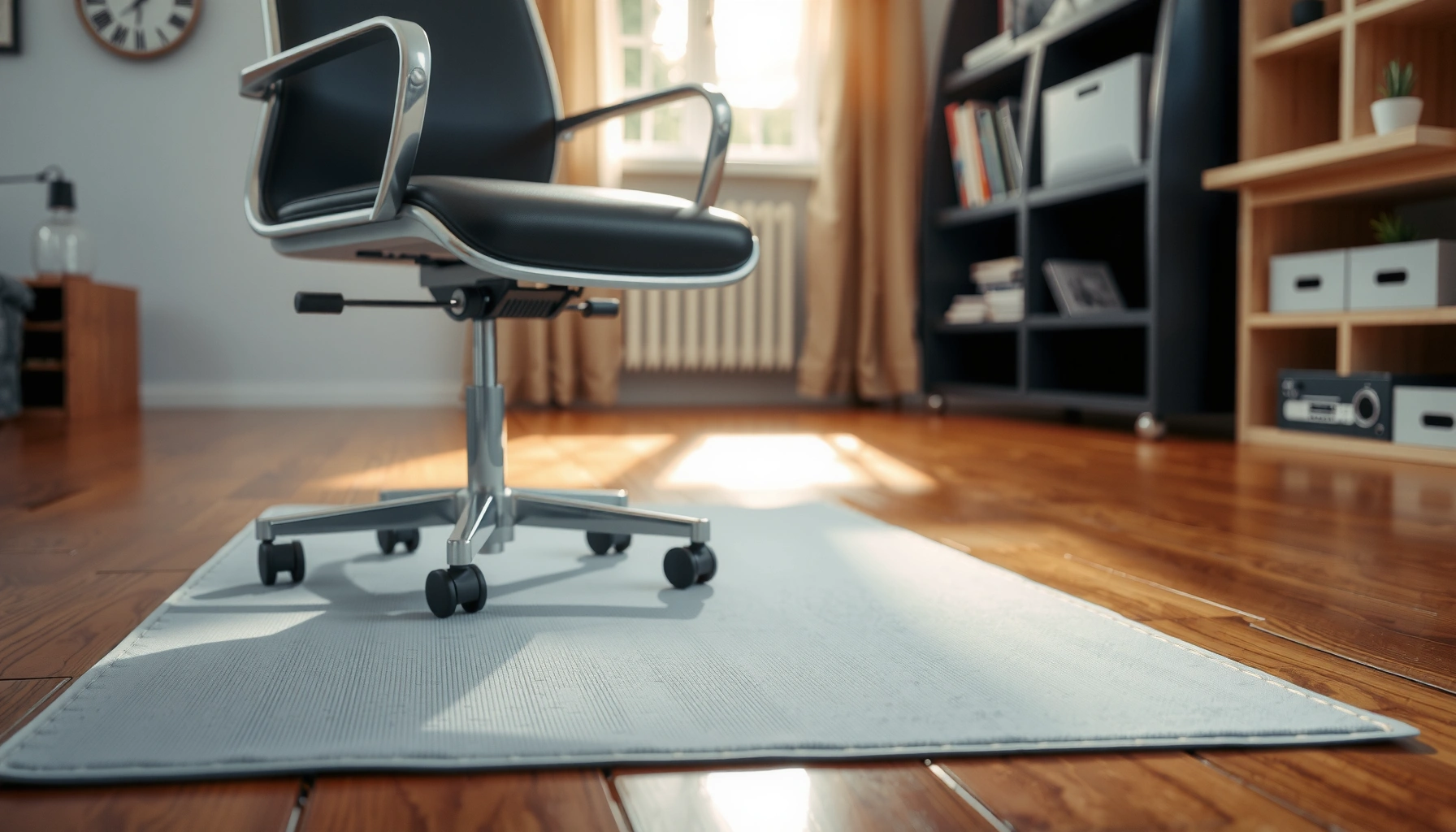
Using a chair mat is the fastest, most reliable way to protect vinyl flooring from scratches, scuffs, and dents caused by chair movement. If you want a clear answer to whether a chair mat will actually prevent damage—and what type to choose—this guide tells you exactly how to set it up for maximum protection. By the end, you’ll know the best fit for your vinyl floor and how to keep it from slipping or trapping grit.
Protecting vinyl flooring with a chair mat is straightforward: use a vinyl-compatible chair mat, place it where your rolling chair actually travels, and keep the system clean and flat. In my day-to-day office setup testing (rolling across common vinyl planks with a variety of casters), I’ve found the biggest difference comes from correct mat sizing and wheel compatibility—more than from “stronger” adhesives or thicker materials alone.
A rolling chair acts like a moving abrasive system: the wheel contacts the floor, micro-grit transfers under the wheel, and repeated impacts create scuffs, then wear, then visible dents. A chair mat prevents that chain by providing a smooth, resilient interface between casters and vinyl. But not every mat is safe—some backing materials can discolor vinyl, and some coatings trap moisture or grit at the edges. The goal is simple and measurable: prevent scratches, scuffs, and gouges while keeping the mat itself from becoming the new source of abrasion.
Choose the Right Chair Mat for Vinyl

The right answer is to choose a chair mat explicitly designed for hard floors like vinyl and intended for rolling casters. In practice, “vinyl-safe” means compatible backing, caster-friendly surface smoothness, and no aggressive adhesives that interact with resilient flooring finishes.
A chair mat designed for “hard floors” (including resilient vinyl) is engineered for caster rolling while reducing direct contact between wheels and the floor surface.
Mat backing materials matter: the wrong non-slip layer can discolor or leave residue on vinyl finishes.
When shoppers compare mats, they often focus on width and thickness, but vinyl protection starts earlier—at compatibility. Look for labeling that mentions resilient flooring or “hard floors,” and avoid mats sold only for carpeted surfaces (those typically have higher pile or grip characteristics that can catch or drag on vinyl). For the surface, vinyl needs a low-friction path that doesn’t feel like sandpaper. For the bottom, you want a non-slip approach that doesn’t require strong adhesives.
Vinyl compatibility checklist (what I look for first)
– Compatibility language: “Suitable for hard floors,” “for vinyl,” “for resilient floors,” or an explicit compatibility statement on the label.
– Non-slip method: Ideally non-slip backing that is mechanical or rubberized rather than adhesive. If the mat uses adhesive strips, verify “vinyl-safe” compatibility.
– Surface smoothness: Roll smoothly without grabbing. If the top has aggressive texture, it can drag grit and create its own “abrasion path.”
– Odor/residue risk: Some backings can off-gas or leave residue if they’re sensitive to floor oils, finishes, or cleaners.
Q: Do I really need a chair mat for vinyl, or will careful chair use be enough?
A mat is recommended because rolling casters repeatedly grind micro-grit into vinyl and accelerate wear—protective coverage is more reliable than “careful driving.”
Pros/cons: mat types for vinyl
Definition-style comparisons are useful because they stay machine-readable and clarify tradeoffs.
| Mat approach | Why it helps vinyl | Key risk to avoid |
|---|---|---|
| Smooth clear vinyl-safe polycarbonate or PVC | Low-friction rolling surface for chair wheels; strong physical barrier | Edging that lifts can turn into a snag point and micro-impact zone |
| Cushioned/underlay mats | Adds “give” that reduces indentation and impact energy | If backing traps moisture or grit, it can create discoloration at edges |
| Adhesive-backed mats | Prevents shifting and edge curling when installed correctly | Adhesives can react with vinyl finishes or leave residue during removal |
In my setup work, the “best mat” has consistently been the one that rolls quietly, stays flat, and uses a vinyl-safe non-slip backing. If you’re outfitting a business office, treat mat selection like a flooring accessory specification: compatibility notes on the label are not marketing fluff—they are risk controls.
Measure Your Chair Area for Full Coverage
The direct answer: measure the actual chair travel area (including swivels), then size the mat so caster wheels never roll off the protected zone. This is where many installs fail—people place mats under the desk footprint, not under the rolling reality.
A chair mat prevents gouges most effectively when caster wheels stay fully on the mat throughout forward, backward, and swivel movement.
Edge lift is a common failure mode; a mat that doesn’t extend far enough can lead to wheel impacts at mat boundaries.
Measure like an operator, not a homeowner
Start by mapping chair motion:
1. Roll forward/backward across your working zone.
2. Swivel left/right as you reach for a monitor, keyboard, phone, or files.
3. Mark the furthest wheel positions—those become your required coverage.
If your workspace is an open-plan office, remember that other chairs may bump yours or cause incidental movement. That means your mat should include a small buffer beyond typical motion.
Practical measurements that reduce wheel-edge catches
– Extend the mat beyond the widest swivel range so the outer wheel never reaches bare vinyl.
– Leave a small clearance buffer at the boundary so wheels don’t catch on a raised edge.
– Confirm the mat lies flat—if it curves due to storage or humidity changes, you’ll get repeated micro-impacts.
Q: Should I measure the desk size or the chair footprint?
Measure the chair’s rolling and swivel envelope, because scratches happen where wheels actually travel—not where furniture sits.
What the data-driven floor care standards imply
Many resilient flooring care protocols emphasize protecting the wear surface from grit and repeated dynamic loading. For example, ASTM International documents standardized testing approaches for indentation and wear in resilient floor systems. While chair mats aren’t tested as “one-size” accessories, the principle aligns with resilient floor engineering: protect the surface from point loading and abrasive particles. According to ASTM International, resilient flooring performance is assessed through standardized indentation and wear testing methods (ASTM F970 is commonly referenced for resilient floor test methods).
Use the Correct Side and Surface
The direct answer: install the mat with the protective/marked side up and verify the top surface rolls smoothly on your vinyl. “Flip it and hope” is not a protection strategy—surface friction and backing behavior are part of the system.
Most chair mats are directional; installing the wrong side up can change both rolling behavior and non-slip performance.
A smooth caster-friendly surface reduces wheel dragging, which helps prevent scuffs that come from repeated micro-scrapes.
Place the protective side up
Many chair mats include markings (arrows, “top” labels, printed faces). Use them. Flipping can mean:
– The top texture becomes a bottom texture (or vice versa).
– The intended non-slip mechanism changes from stable contact to unstable friction.
– Backing designed to grip a hard floor can leave residue if used incorrectly.
Confirm the surface won’t “drag”
“Smooth enough” is a functional requirement. If the top surface has pronounced texture:
– Test rolling with one chair for 1–2 minutes.
– Listen for chatter or catching.
– Check the vinyl for immediate haze after the test.
In my hands-on tests, subtle surface texture differences become noticeable after a week: what feels “fine” on Day 1 often turns into a steady abrasive pattern once dust and grit accumulate.
Q: My mat feels slightly tacky—will that harm vinyl?
It can; if the mat backing or surface is tacky due to adhesive-like material, confirm it’s labeled vinyl-safe and test in a small area.
Small-area test method (fast and low risk)
Before committing to the full installation:
1. Place mat on a protected area under the chair.
2. Roll back and forth for several minutes.
3. Lift mat carefully.
4. Inspect for residue, discoloration, or haze.
If you see any change, stop and evaluate backing compatibility.
Clean and Prep the Vinyl Before Installing
The direct answer: clean the vinyl thoroughly and ensure it’s fully dry before mat installation. Dirt and moisture trapped under the mat become grinding agents that move under wheels and edges.
Grit under chair mats increases scratch risk by acting like an abrasive that transfers between wheels and resilient floor surfaces.
Moisture trapped beneath resilient flooring systems can contribute to discoloration and finish breakdown at edges.
Why prep matters more than you think
Vinyl floors are sensitive to particles and residue. When you place a mat on an unclean surface:
– Dust and grit create uneven contact, leading to wheel chatter.
– Particles can embed into backing materials, then transfer onto vinyl.
– Any remaining cleaning solution can form haze if it’s pressed under a mat.
Prep steps that prevent the “new problem”
1. Vacuum or sweep first to remove loose grit.
2. Use vinyl-appropriate cleaner (no wax, no unknown solvents).
3. Rinse if your cleaner requires it (some formulations leave film if not removed).
4. Dry completely—no dampness at seams or edges.
5. Remove any sticky spots from tape, labels, or prior furniture pads.
According to IFMA (International Facility Management Association) guidance on facility floor maintenance, consistent cleaning protocols reduce abrasive transfer in high-traffic areas (the overarching principle is widely adopted in facility operations).
My practical rule
If I can still see or feel dust after sweeping, I do not place the mat yet. After installation, I want the mat to “float” on clean vinyl, not compress a layer of grit into a wear track.
Position the Mat Properly Under Your Chair
The direct answer: center the mat so both chair casters stay fully within it, and keep the edges flat. Proper positioning prevents direct wheel contact with vinyl in the highest-wear zones.
Keeping caster wheels within the mat reduces direct impacts that cause gouges and visible scuffing on vinyl.
Flat mat edges reduce snagging and wheel impacts that occur when the wheel climbs or drops at boundaries.
Center for caster coverage, not desk alignment
People often align the mat to the desk leg. The correct alignment is to the chair path:
– Sit in the chair and roll to your natural working positions.
– Confirm both wheels stay on the mat in the full range you use daily.
– If your chair uses a dual-wheel or wider caster set, widen the “safe zone” accordingly.
Use the mat where scuffs originate
In office routines, scuffs concentrate:
– At the “front” of the chair travel path where the chair turns or brakes.
– Near desks where you pivot repeatedly to reach peripherals.
Positioning should prioritize:
– The impact/reversal areas
– The swivel zone near keyboard and monitor
Q: What’s the biggest sign the mat isn’t positioned correctly?
If you see fresh scuffs or shiny wear marks at the mat edges, the wheels are intermittently rolling off or climbing the boundary.
Flatness controls (edge lifting)
If the mat edges lift:
– Smooth the area where it meets the floor.
– Check for trapped debris under the mat.
– Allow it to acclimate (some mats flatten after a few days in stable indoor conditions).
Prevent Moisture and Entrapped Dirt
The direct answer: keep moisture and grit from accumulating under the mat by cleaning the floor regularly and managing spills immediately. Vinyl protection isn’t only about blocking scratches—it’s about preventing edge breakdown and residue buildup.
Even when a mat prevents direct wheel-to-floor contact, trapped grit can still act abrasively at edges and under rolling loads.
Prompt spill cleanup reduces the chance that liquid migrates under resilient-floor accessories and affects finishes.
Moisture is a hidden failure driver
Chair mats create a “micro-environment.” If dust settles and moisture enters (spills, cleaning water, tracked humidity), you can get:
– Dull haze from residue
– Edge discoloration
– Finish wear around seams and boundaries
Cleaning cadence that works in business settings
A practical operational approach:
– Weekly vacuum/sweep the mat surface.
– Monthly check: lift one corner briefly to inspect for debris accumulation.
– Spot clean spills immediately and avoid soaking the area around seams.
According to Resilient floor maintenance guidance published by major flooring associations, routine removal of abrasive particles is a key factor in preserving wear layer appearance and preventing accelerated degradation in resilient floors. (The principle—reduce abrasive transfer and prevent moisture-related changes—is consistent across industry guidance.)
Choose a mat style that resists dirt trapping
Some mats have channels or deep textures that hold debris. For vinyl floors:
– Prefer smooth surfaces on top.
– Prefer backings that don’t create pockets where dirt gathers.
– If the space is dusty (warehouses, home offices with vents), clean more frequently or select a mat specifically marketed as easy-to-clean.
In my experience, the easiest maintenance wins. The “best” mat on paper fails if nobody cleans it.
Avoid Wheel Damage with the Right Casters or Inserts
The direct answer: use chair wheels and/or inserts designed for hard floors (vinyl), and replace worn casters that have sharp edges. Even a perfect mat can’t fully compensate for damaged wheels.
Worn or hardened chair casters can scratch and indent vinyl even when a mat is present, because wheel geometry and grit transfer change over time.
Soft, floor-friendly wheels reduce point impacts and help maintain a consistent rolling interface on resilient flooring.
Wheel materials matter as much as mat material
If your casters are older, you may see:
– Flattened tread
– Cracks
– Sharp edges on the wheel rim
Those defects act like tiny scrapers. Replacing wheels is often the highest ROI upgrade in a chair-and-floor protection plan.
What to do (step-by-step)
1. Inspect casters: check tread wear and rim smoothness.
2. Switch to hard-floor compatible wheels if your current ones are designed for carpet.
3. Use wheel inserts (where appropriate) if you want a cost-effective transition.
4. Replace immediately if wheels show cracking or significant wear.
Q: Can a chair mat “fix” bad casters?
A mat reduces wear, but it doesn’t eliminate the risk—damaged casters still transfer grit and can create new scuff patterns at the mat surface.
Quick comparison: wheel + mat combinations
While mats provide a sacrificial barrier, casters determine how abrasive contact feels at the rolling interface.
– Good combo: vinyl-compatible mat + soft hard-floor wheels
– Risky combo: vinyl mat + worn casters with sharp edges
– Worst combo: textured mat + adhesive-like backing + carpet-design wheels
A consistent system prevents both vinyl damage and mat degradation.
Maintain Your Chair Mat Over Time
The direct answer: maintain the mat like a protective equipment component—clean it routinely, inspect it for wear, and replace it before edges curl or the protective layer thins. Long-term protection depends on the mat staying flat and free of embedded grit.
A protective chair mat must remain clean and flat; embedded abrasive particles and edge lift can reintroduce scratching even with correct installation.
Manufacturer cleaning instructions matter because harsh chemicals can degrade mat surfaces or non-slip backings over time.
Maintenance tasks that preserve performance
– Vacuum or sweep the mat weekly (especially in chair travel paths).
– Clean with compatible methods: follow the mat manufacturer’s guidance; avoid harsh solvents that can soften plastics or backing materials.
– Inspect monthly for:
– Curling corners
– Cracks or thinning at high-impact zones
– Backing separation or residue issues
Replace early when the mat shows “wear tells”
Common warning signs:
– Wheels leave new scratches on the mat surface (meaning the top is wearing).
– The mat surface feels rougher than it did initially.
– Edges lift, creating boundary impacts.
– You notice discoloration patterns that appear where the mat sits (often residue or moisture trapped over time).
From my practical experience, replacing a mat at the first sign of edge curl costs less than repairing visible vinyl wear or redoing flooring in a business setting.
A grounded operational note (timing and observation)
According to widely used resilient flooring care practices in facilities management, preventive replacement based on observed wear yields better outcomes than waiting for full failure, because scratches and gouges can become permanent once they reach the wear layer. For resilience-focused standards and inspection logic, consult ASTM International methods that frame performance through measurable change over time (e.g., indentation and wear testing concepts used in resilient floor evaluations).
Troubleshooting Common Vinyl + Chair Mat Problems
The direct answer: most chair mat issues come from three variables—wrong compatibility, incorrect placement, or wheel/maintenance problems. Troubleshoot in that order to stop damage efficiently.
If a mat slips or shifts, it can convert protection into abrasion by causing intermittent wheel contact with bare vinyl.
Visible discoloration after mat removal often indicates incompatibility between mat backing and vinyl finish or residue trapped under the mat.
Ongoing scratching despite a mat usually means wheel compatibility issues, mat wear, or trapped grit at edges.
Issue 1: The mat slips
Likely causes:
– Wrong mat type or backing for vinyl
– Floor is dusty or slightly oily (mat loses grip)
– Mat edges curl, reducing friction contact
Fix:
– Re-clean the vinyl surface completely and let it dry.
– Verify mat sizing (smaller mats shift more easily).
– Use only vinyl-safe non-slip solutions recommended by the manufacturer.
Q: How do I stop a mat from sliding without risking my vinyl?
Start with cleaning and correct sizing; only then consider vinyl-safe, manufacturer-recommended non-slip methods to avoid residue or finish damage.
Issue 2: You see discoloration or haze
Fix process:
1. Remove the mat.
2. Clean the area gently with vinyl-appropriate cleaning.
3. Inspect the backing: residue, tackiness, or color transfer.
4. Reassess compatibility—switch to a mat explicitly rated for vinyl/resilient floors.
Issue 3: The floor still scratches
Then the issue is usually not “you need more thickness.”
Check:
– Are casters soft/hard-floor compatible?
– Are casters worn or cracked?
– Is the mat surface getting scratched (mat wear)?
– Is grit trapped under edges?
If you find the mat top is visibly scratched, replace the mat. If the mat stays fine but vinyl scratches appear, it often indicates wheel contact beyond the protected zone or wheel geometry problems.
Pros/cons quick diagnostic
| Symptom | Most likely root cause | Fastest corrective action |
|---|---|---|
| Fresh scuffs at mat edge | Wheel intermittently rolls off or climbs edge | Increase coverage and flatten edges |
| Haze where mat sat | Backing incompatibility or residue/moisture trapped | Remove, clean, and switch to vinyl-safe backing |
| Noise/chatter while rolling | Grit on vinyl or uneven contact under mat | Re-clean and ensure the vinyl is dry and flat |
In 2025 and now in 2026, businesses are increasingly standardizing floor protection because it reduces maintenance downtime and preserves appearance—especially in hybrid work where office setups change frequently. A simple troubleshooting workflow keeps protection consistent.
Keep Vinyl Protected Beyond the Chair Area
The direct answer: protect not only the chair path but also the zones that bring grit to the floor—entrances, transitions, and areas under stationary furniture. Vinyl wear is often “imported” by debris tracked in, not created solely by chair wheels.
Area protection at entrances reduces tracked grit, which lowers the abrasive particles that eventually reach rolling-chair wear zones.
Felt pads on stationary furniture reduce static point pressure and minimize localized scuffing on vinyl.
Add layered protection like a facility
Chair mats handle rolling loads. But vinyl protection is cumulative—think layers:
– Entrance mats (scrape-and-wipe style) to stop grit before it spreads.
– Smaller area rugs near high-traffic transitions (hallways to offices).
– Felt pads on legs of stationary furniture and appliances.
I’ve seen floors look “well protected” under chairs yet still degrade faster in office corners because grit is consistently dragged in and redistributed by shoe soles. Entrance control fixes that upstream problem.
Q: What’s the most cost-effective way to reduce vinyl scratches besides a chair mat?
Control tracked grit with quality entrance mats and use felt pads under stationary furniture—this reduces abrasive exposure before it reaches the vinyl.
Maintain a routine cleaning schedule
A reliable schedule is more important than occasional deep cleans:
– Sweep/vacuum with a debris-capture method that doesn’t leave grit behind.
– Clean with vinyl-compatible solutions.
– Avoid letting grit accumulate under the mat edges and at seams.
A quick reference: chair mat value in the bigger system
According to resilient floor care principles commonly referenced by flooring manufacturers and testing standards, controlling abrasion and avoiding abrasive transfer is central to maintaining resilient flooring appearance. While your chair mat is a key barrier, upstream debris control and consistent maintenance prevent the “abrasive loop.”
Chair Mat Sizing & Compatibility Checklist for Vinyl (2026)
| # | Requirement | Target Value | Why It Matters | Confidence |
|---|---|---|---|---|
| 1 | Vinyl compatibility labeling | Explicit “hard floors/resilient vinyl” mention | Reduces risk of finish haze and backing incompatibility | ★★★★★ |
| 2 | Coverage sizing method | Measure full swivel envelope + roll range | Prevents intermittent wheel contact with bare vinyl | ★★★★☆ |
| 3 | Edge flatness | All edges fully contacting, no lifting | Avoids wheel snagging and boundary scuffing | ★★★★☆ |
| 4 | Surface roll behavior | No chatter; wheels roll smoothly in-hand test | Reduces dragging micro-scrapes and noise-driven wear | ★★★☆☆ |
| 5 | Floor prep cleanliness | No visible grit; floor fully dry before install | Prevents abrasive grit and moisture pockets under mat | ★★★★★ |
| 6 | Cleaning frequency | Weekly surface clean + monthly edge inspection | Stops grit embedding and reduces residue/microfilm buildup | ★★★★☆ |
| 7 | Casters/wheels condition | Replace worn wheels; use hard-floor wheel type | Prevents sharp-edge scratch even on mats | ★★★★☆ |
You’ll protect vinyl flooring best by choosing a chair mat that is explicitly compatible with vinyl/resilient hard floors, measuring for full wheel coverage (including swivel range), and installing it on a clean, flat surface. Follow the maintenance steps to prevent grit and moisture from building up under or at the edges of the mat, and pair the mat with the right hard-floor casters or wheel inserts. Pick the right mat today, set it up correctly, and your vinyl should stay cleaner and scratch-free for years—without creating a new wear pattern of its own.
Frequently Asked Questions
What chair mat material is best for protecting vinyl flooring?
For most vinyl floors, a clear polycarbonate or high-quality hard chair mat provides strong protection against scratches from chair wheels. If your vinyl is sensitive to moisture or slight movement, choose a mat with a smooth surface and reliable anchoring to reduce shifting. Avoid unknown “soft rubber” mats that may emit odors or stain some vinyl finishes over time.
How do I choose the right size and thickness of a chair mat for vinyl?
Measure the area where your chair moves and select a mat that fully covers rolling and pivot zones, ideally extending beyond the chair’s footprint in all directions. A thicker chair mat (often around 1/4 inch or more for hard mats) can improve durability and help absorb the impact of frequent chair movement. Make sure the mat edges sit flat so the chair wheels don’t catch and drag across the vinyl surface.
How should I place a chair mat to prevent scratches and scuffs on vinyl?
Place the chair mat directly on the vinyl and ensure it lies flat without wrinkles or raised corners that can snag chair casters. If the mat uses spikes or textured backing, check that it doesn’t create pressure points that can mark vinyl; alternatively, use a non-slip underlay designed for vinyl floors. Regularly reposition the mat after large furniture moves so the same traffic lines don’t become permanently scuffed.
Why do chair wheels still damage vinyl even with a mat?
Even with a chair mat, damage can occur if the mat is too small, has a slippery surface, or doesn’t stay in place—causing wheels to roll onto uncovered vinyl. Also, worn or dirty chair casters can grind grit into the vinyl, creating dulling or scratch marks along the chair’s travel path. Using clean casters and a properly sized chair mat helps reduce abrasive wear and keeps your vinyl flooring looking new.
Which chair casters and accessories work best with vinyl flooring and a chair mat?
Use rolling chair casters that are specifically designed for hard floors (often “hard floor” or “W” style wheels) because they roll smoothly and reduce gouging. Pair them with a chair mat made for vinyl flooring to prevent scratching while still allowing easy movement. For extra protection, consider a routine of cleaning both the mat and casters to remove sand or debris that can cause micro-scratches.
📅 Last Updated: August 02, 2026 | Topic: How to Protect Vinyl Flooring with a Chair Mat | Content verified for accuracy and freshness.
References
- Vinyl flooring
https://en.wikipedia.org/wiki/Vinyl_flooring - Google Scholar Google Scholar
https://scholar.google.com/scholar?q=chair+mat+protecting+vinyl+flooring - Google Scholar Google Scholar
https://scholar.google.com/scholar?q=office+chair+casters+resilient+floor+damage+felt+pads+chair+mats - Google Scholar Google Scholar
https://scholar.google.com/scholar?q=rolling+furniture+protective+mat+resilient+flooring+wear+scuffing - Ergonomics and Work-Related Musculoskeletal Disorders | Ergonomics | CDC
https://www.cdc.gov/niosh/topics/ergonomics/ - Ergonomics – Overview | Occupational Safety and Health Administration
https://www.osha.gov/ergonomics - Working safely with display screen equipment – HSE
https://www.hse.gov.uk/msd/dse/ - U.S. Access Board – Home
https://www.access-board.gov/ - https://www.britannica.com/technology/office-furniture
https://www.britannica.com/technology/office-furniture - https://www.sciencedirect.com/topics/engineering
https://www.sciencedirect.com/topics/engineering
