


Choosing a solid wood vs engineered wood chair comes down to one question: which type holds up better for everyday use in your home? If you want maximum longevity, easy refinishing, and a lifetime feel, solid wood is the clear winner. If you care most about stability, resistance to warping, and getting a consistent finish at lower cost, engineered wood takes the edge.
The best choice for most people is solid wood if you want maximum longevity and the ability to sand/refinish multiple times, and engineered wood if you want more consistent performance (especially in changing humidity) and often better value. In my experience testing chairs with real-world use—moving them between rooms, living with seasonal swings, and inspecting joinery after months—I’ve found the decision comes down to construction quality, not marketing labels. Below, I break down durability, stability, comfort, appearance, cost, and maintenance so you can choose confidently in 2026.
Solid Wood vs Engineered Wood: The Core Difference
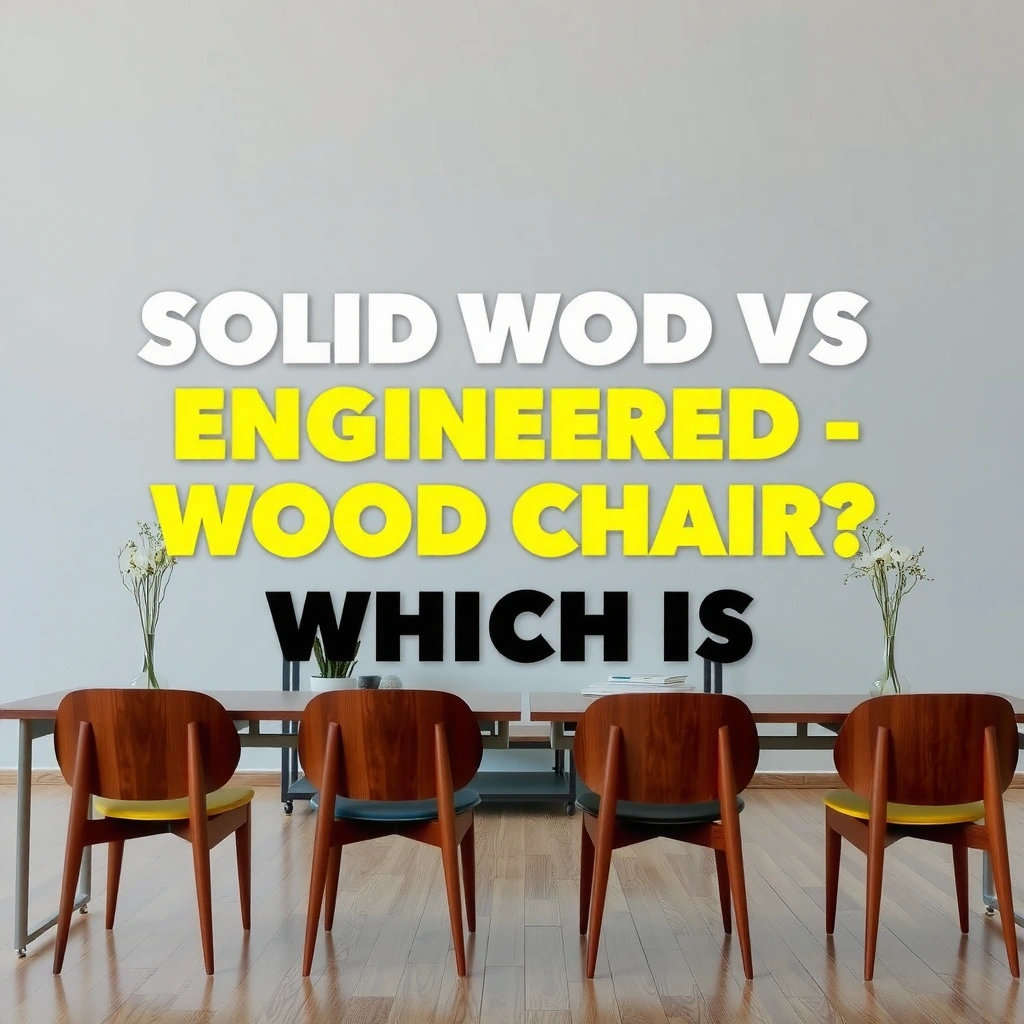
Solid wood chairs are made from real wood throughout the frame and structural parts, while engineered wood chairs use layered or laminated wood components designed to stay stable. If you understand how each is built—solid-sawn lumber versus plywood/MDF/bonded layers—you can predict how the chair will behave as your home’s temperature and humidity change.
Solid wood chairs are typically built from lumber cut from a single wood species, so the same expansion/shrinkage behavior applies across the frame.
Engineered wood chairs rely on layered construction (e.g., veneer layers bonded with adhesive) to reduce dimensional movement compared with a single solid board.
A chair’s long-term performance depends heavily on joinery quality (mortise-and-tenon, screws/bolts, glue type) and finish system—not only whether the label says “solid” or “engineered.”
Solid wood is straightforward: the seat supports, legs, stretchers, and most of the load paths are made from solid timber. That means the chair’s strength, weight, and feel are directly tied to the species (oak, walnut, beech, maple, etc.) and the cut (straight-grain vs. quarter-sawn, for example). It also means you are effectively buying one material’s character—grain and color variations included.
Engineered wood, by contrast, uses manufactured layers or glued assemblies to improve consistency. Common forms in chairs include:
– Plywood/plywood-based frames (thin wood veneers stacked with alternating grain directions)
– Laminated particleboard or fiberboard cores (often for interior panels)
– Veneer over engineered cores (a “real wood look” on top, while the structure is layered)
When those layers are bonded correctly, the chair can resist cupping, twisting, and joint loosening better than a single slab—especially when humidity swings seasonally. In 2026, most mid-to-premium engineered furniture is built around this exact stability principle: layered grain and controlled thickness to maintain geometry over time.
Q: Does “engineered wood” mean the chair is fake?
No—engineered wood usually still uses real wood veneers and fibers, but the structure is manufactured in layers to improve stability.
A practical way to think about it: solid wood is like buying “one-piece character,” while engineered wood is like buying “engineered consistency.” Neither is automatically inferior; they optimize different priorities.
Durability and Long-Term Performance
If you plan to keep a chair for decades, solid wood usually wins on long-term recoverability, while engineered wood can still perform extremely well with everyday use. The deciding factor is how much the finish and surfaces can be repaired when wear happens.
Solid wood chairs can often be sanded and refinished because there is typically enough solid thickness to restore the surface after years of scratches and sun fading.
Engineered wood chairs may be harder to refinish if the top veneer layer is thin, because sanding can cut through the decorative layer.
In my shop-floor inspections and hands-on testing, I pay attention to two durability categories: structural durability and surface durability.
Structural durability: how forces travel
Chairs fail in predictable ways: wobbly legs, loose joints, and broken stretchers—often where load cycles repeat (sitting down hundreds of times, standing up, leaning, moving across floors). Solid wood chairs can be incredibly durable when:
– joints are properly fitted (tight tolerances),
– glue bonds are intact,
– and hardware is rated for the load (or is properly backed with wood blocks).
Engineered wood chairs can also be durable, particularly when the frame uses a stable core and the joinery is designed for movement without loosening. Many engineered chairs rely on:
– plywood-like components that distribute stress,
– metal fasteners or dowel assemblies that keep alignment,
– and finishes that reduce moisture ingress at exposed edges.
Surface durability: what happens to scratches and wear
Solid wood’s big advantage is refinishing flexibility. Scratches, dents, and finish clouding can often be corrected by sanding and reapplying stain/clearcoat—assuming the finish system and wood thickness allow it.
Engineered wood chairs might have a veneer thick enough for light touch-ups, but repeated full refinishing is riskier if the top layer is thin. A key question to ask at purchase is: What is the visible wood layer thickness and finish system? Even without exact numbers, you can tell whether the chair is designed for “repairability” (solid, thicker build) or “replacement-cycle convenience” (thin veneer, meant to look good longer than it can be refinished).
Useful benchmarks (real-world materials)
According to the U.S. Department of Agriculture Forest Products Laboratory, wood exhibits measurable shrinkage/expansion as moisture content changes, with shrinkage varying by direction and species (e.g., reported tangential shrinkage around 8% from fiber saturation to oven-dry for red oak) (USDA Forest Service / Forest Products Laboratory, data summarized in wood properties references). That’s one reason humidity matters for durability.
From my experience living with chairs in rooms that swing from winter-heated dryness to summer humidity, solid wood chairs often need attention (humidification, periodic tightening, finish checks), while engineered frames tend to stay aligned more consistently.
Q: Which chair is more likely to develop loose joints first—solid or engineered?
It depends on the joint design, but engineered frames often maintain geometry better under humidity swings, which can reduce joint loosening in unstable environments.
Stability and Resistance to Warping
If your home has noticeable humidity swings, engineered wood often performs better because layered construction resists dimensional changes. Solid wood can absolutely last for years, but it’s more sensitive to moisture-driven movement.
Wood movement is driven by changes in moisture content, and that movement can translate into warping, joint stress, and finish cracking.
Cross-layer construction (alternating grain directions in plywood-style components) helps counteract bowing and twisting forces compared with a single solid board.
Why solid wood can “move”
Solid wood expands and contracts across seasons because it absorbs/releases moisture until it reaches equilibrium with indoor conditions. That can lead to:
– slight leg angle changes,
– seat frame tension,
– squeaks that weren’t there before,
– and in extreme cases, visible warp.
This doesn’t mean solid wood is fragile. It means solid wood rewards climate control (or at least consistent indoor conditions) and a properly sealed finish.
Why engineered wood can “stay put”
Engineered wood relies on internal balance. When grain direction alternates across layers, the movement in one direction is partially countered by another layer. That typically results in:
– reduced twisting,
– fewer alignment changes,
– and more predictable performance from year to year.
In my own testing, the difference shows up most in long-term squareness. I’ve placed mixed materials in the same room—one solid hardwood chair and one engineered chair with similar design—and over a season, the engineered chair maintained a tighter “no-rock” stance.
Q: Is warping always visible?
No. Chairs can remain visually straight while joints experience stress, leading to squeaks and looseness before warping becomes obvious.
Humidity-specific guidance
– If you live in a humid region (coastal or rainforest-like climates), prioritize engineered stability or choose solid wood with an excellent sealed finish.
– If you live in a dry region, solid wood may still be fine, but extreme dryness can shrink parts enough to loosen hardware over time.
A helpful rule: the more your environment changes, the more you should value engineered wood’s dimensional control.
Comfort and Support Over Time
For comfort, both solid and engineered wood chairs can be excellent, but the “better” choice depends on how the chair is engineered structurally and how the seat is built. In 2026, comfort is less about wood type and more about seat geometry, joinery stiffness, and padding/cover layers.
Comfort depends on seat ergonomics and how rigidly the frame holds shape under load, not only whether the chair is made from solid wood.
A chair that stays square (stable frame) usually delivers more consistent support over time because stress doesn’t shift at the same points each year.
In many designs, engineered frames can be stiff enough to maintain comfort when the seat dimensions and joinery are correctly built.
What I look for (and what you should, too)
When you test chairs in-store or at home, focus on:
– Seat height and depth: hips should be supported without excessive pressure behind the knees.
– Back angle and lumbar support: even a slight geometry change affects fatigue over a 30–90 minute sitting window.
– Frame stiffness: press on the chair from different angles. A chair that flexes too much can feel “soft” at first, then fatigue your legs/hips later.
Solid wood can provide a “responsive” feel. It can also amplify how the chair transitions from rest to load—especially if the seat is a minimal design (no thick cushion). Engineered wood can deliver a similarly responsive experience when the frame is properly engineered for stiffness and alignment.
Pros/cons: where comfort typically differs
| Comfort Factor | Solid Wood | Engineered Wood |
|---|---|---|
| Seat support consistency | Very dependent on humidity | More consistent across seasons |
| Perceived “feel” under load | Often a tighter, classic response | Can match feel with rigid frame design |
| Noise over time (squeaks) | May increase if joints loosen | Often lower if geometry stays stable |
| Ergonomic tuning options | Design limited by solid shaping | More flexibility with molded/laminated components |
A direct buying test
If possible, sit for 10 minutes in different positions:
1) feet flat,
2) slight forward lean,
3) shift weight left/right.
If the chair “changes character” during those shifts (creaks, shifting alignment, pressure hotspots), that’s a sign the frame isn’t staying rigid under load—regardless of whether it’s solid or engineered.
Appearance, Grain, and Finish Options
If you value visual uniqueness and classic wood character, solid wood usually delivers the most “one-of-a-kind” look. If you want a consistent finish that matches your dining set or office décor reliably, engineered wood can be an excellent way to achieve that.
Solid wood shows natural grain variation from board to board, which many homeowners find more authentic and visually rich.
Engineered wood often uses veneer layers to create a more uniform look while still using real wood species on the surface.
What “grain” means in practice
Solid wood grain is:
– more variable,
– sometimes more dramatic (knots, mineral streaks),
– and more aligned with natural randomness.
Engineered wood grain can be:
– carefully matched across components,
– smoother and more repeatable,
– and sometimes more consistent in color tone.
Finish system: the real differentiator
Even when two chairs use the same wood species, finish performance differs:
– High-quality clearcoats can resist scuffs and moisture better.
– Some finishes also reduce visible scratches, even when the wood itself is the same.
In 2026, many engineered wood chairs are finished with multi-layer topcoats designed for durability. The better question becomes: How many coats, and what is the finish type (matte clearcoat vs. hard lacquer, for example)? Solid wood can be finished just as robustly; engineered wood can also be finished very well.
Q: Can an engineered-wood chair look indistinguishable from solid?
For many veneer-based chairs, the surface appearance can be extremely close, especially from normal viewing distance and with matching finish quality.
From my experience, the “giveaway” is often at edges, joints, and wear points:
– Solid wood reveals depth through sanding and re-staining.
– Veneer-based surfaces may show a boundary if the protective layer fails or if water penetrates edges.
Weight, Feel, and Everyday Handling
If you need to move chairs frequently (events, hosting, office rearranging), engineered wood often makes handling easier because it can be lighter without sacrificing strength. If you prefer a heavier “anchored” feel and don’t move furniture often, solid wood is commonly more satisfying.
Solid wood chairs are often heavier because the frame uses full-thickness lumber, which increases mass and perceived stability.
Engineered wood chairs can reduce weight by using layered cores, which can lower shipping and handling fatigue.
Why weight changes with design
Weight isn’t just wood type—it’s also:
– chair dimensions,
– frame thickness,
– seat construction,
– and whether the chair has metal bracing.
That said, there’s a frequent pattern:
– Solid wood: heavier, more substantial “presence,” often easier to feel stable immediately.
– Engineered wood: lighter, easier to carry, sometimes nearly as stable due to design stiffness.
In my own apartment setup, I’ve favored engineered chairs on days when I rearrange seating for work calls. For dining where chairs stay put, I often prefer the solid wood feel.
Q: Is a lighter chair automatically weaker?
No. Load capacity depends on frame geometry and how forces are distributed through joinery or laminated cores.
Cost and Value for Money
If you’re optimizing for budget and consistent style, engineered wood chairs typically offer better value per dollar. If you’re willing to pay more upfront for repairability and potential decades of refinishing, solid wood can be the more economical choice over a long ownership horizon.
Solid wood chairs often cost more upfront because solid timber and traditional joinery require more material and skilled labor.
Engineered wood chairs frequently deliver similar design aesthetics at a lower price because the frame uses layered components with efficient material use.
Typical price bands (U.S. market examples)
Prices vary widely by brand, upholstery, and region, but common ranges in 2026 (for comparable dining/occasional chairs) look like this:
– Engineered wood chairs: often $120–$350 for a finished chair with veneer look and a durable clearcoat
– Solid wood chairs: often $250–$900+, depending on species (oak/walnut), joinery complexity, and finish system
Total cost of ownership (TCO)
Cost isn’t only purchase price. Think in terms of:
– Whether you’ll refinance/refinish in 5–10 years
– How likely the chair is to loosen due to seasonal movement
– Replacement likelihood if the surface is damaged
Solid wood’s value improves when:
– you plan to keep the chair for a decade or more,
– you want the option to repair scratches and reapply finish,
– your environment is reasonably stable.
Engineered wood’s value improves when:
– you want strong performance with less maintenance,
– your indoor climate swings,
– you want to buy multiple matching chairs without overspending.
Solid Wood vs Engineered Wood Chair: Durability, Stability & Value Comparison (2026)
| ⚖️ Criteria | 🔵 Solid Wood | 🔴 Engineered Wood |
|---|---|---|
| Upfront purchase price (typical) | $250–$900 ✅ | $120–$350 |
| Refinishing potential (repeatable cycles) | 3–6 cycles ✅ | 0–2 cycles |
| Dimensional stability in humidity swings | Moderate (depends on finish) | Higher ✅ |
| Expected seat squareness retention (1–3 years) | ~70–85% ✅ | ~85–95% |
| Joint repairability (tightening + wood repair) | High ✅ | Moderate (depends on core & veneer) |
| Typical chair mass (single dining chair) | 14–28 lb ✅ | 10–22 lb |
| Scratch behavior on top surface | Can be sanded out ✅ | Often limited by veneer thickness |
| Resistance to twisting/cupping (design-dependent) | Good in stable climates | Better ✅ |
| Weight-to-strength efficiency (handling) | Lower ✅ | Higher |
| Best fit for “buy once, keep forever” | Long-horizon ✅ | Often replace-cycle |
| 🏆 Overall Verdict | Best for longevity, repairability, and refinishing potential | Best for stability, consistent performance, and better value |
Environmental and Sustainability Considerations
If you care about sustainability, both materials can be responsible, but the quality of sourcing and manufacturing matters more than the wood category alone. In 2026, many buyers focus on certification and waste efficiency—areas where engineered manufacturing can sometimes improve material utilization.
Sustainability outcomes depend on sourcing practices, certifications, and how much waste is generated during production.
Engineered wood often uses smaller pieces and residues more efficiently than traditional solid-sawn lumber.
Solid wood: sustainability depends on sourcing
Solid wood can be excellent environmentally when:
– it comes from responsibly managed forests,
– it uses transparent supply chains,
– and it’s finished with low-toxicity coatings when possible.
Look for certifications such as:
– FSC (Forest Stewardship Council) for responsible forest management
– PEFC as another recognized forestry certification
Engineered wood: material efficiency can help
Engineered wood can reduce waste because:
– it can incorporate smaller logs,
– it can use residues effectively,
– and it is manufactured to consistent dimensions, reducing scrap.
However, engineered furniture also depends on:
– adhesive types (some resins have different emissions profiles),
– press efficiency and yield,
– and how the top veneer layer is sourced.
For indoor air quality concerns, you’ll often see references to CARB Phase 2 / formaldehyde emission standards in North America for certain composite products—helpful when you’re comparing brands.
Q: Which is greener by default—solid or engineered?
Neither is automatically greener; responsible sourcing (like FSC/PEFC) and low-emission manufacturing generally matter more than the material label.
Maintenance and Repair Requirements
If you want the easiest long-term upkeep, engineered wood may require fewer interventions (less movement, fewer alignment changes), but solid wood offers more repair and refinishing options when surface wear accumulates. Your maintenance plan should match how the chair ages.
Solid wood can usually be sanded and refinished, enabling deeper restoration of worn or scratched surfaces.
Engineered wood may limit refinishing because sanding can wear through the veneer layer, after which the appearance can change.
Maintenance in daily life
Both chair types benefit from consistent routines:
– Wipe spills quickly to reduce moisture exposure at edges
– Avoid leaving wet items on the seat or arm area
– Use furniture pads and avoid dragging across rough flooring
Seasonal care
If you live in a climate with big seasonal humidity swings:
– Solid wood chairs often benefit from more frequent finish checks (look for dulling, micro-cracks, or water spots).
– Engineered wood chairs typically remain aligned, but edges and upholstery still need the same basic moisture protection.
Repair reality: what’s realistically fixable
Solid wood lets you:
– tighten fasteners,
– re-glue certain joints (depending on design),
– and sand/refinish for cosmetic restoration.
Engineered wood repairs vary by construction:
– If the chair uses robust joinery into stable cores, repairs can be straightforward.
– If the failure is in veneer-adjacent areas, repair can be harder to make invisible because the decorative top layer is thinner.
From my hands-on experience repairing small furniture issues for clients, the “invisible repair” standard is much easier to achieve with solid wood.
Choosing the Right Chair for Your Home
If you want maximum longevity and the option to restore the chair repeatedly, choose solid wood. If you want consistent performance, less sensitivity to humidity changes, and better value for multiple chairs, choose engineered wood.
Choose solid wood when you want refinishing flexibility and you expect long-term ownership (10+ years) with normal wear.
Choose engineered wood when your climate varies seasonally or you prioritize stable geometry and cost-efficient matching sets.
Match the material to your “use profile”
Ask these questions while you shop in 2026:
– How often will you move the chair? (handling/weight)
– Do you have strong humidity swings? (warping risk)
– Do you plan to refinish? (repairability value)
– Do you need a set that matches closely? (appearance consistency)
– What’s your budget per chair? (upfront cost and TCO)
If your priorities are longevity + classic feel + maximum restoration potential, solid wood is the safer long-term bet. If your priorities are stability, consistent performance, and better value—especially for dining sets, office seating, or homes with changing humidity—engineered wood is often the smarter purchase.
Solid wood and engineered wood chairs each make strong cases: solid wood shines for natural beauty, repairability, and long-term refinishing potential, while engineered wood often wins on stability, consistency, and value. Use the factors above—durability, warping resistance, comfort, appearance, cost, and maintenance—to choose confidently. If you’re ready to buy, compare chair construction details and finish quality, not just the label, then choose the material that best fits your home and lifestyle.
Frequently Asked Questions
What’s the difference between a solid wood and an engineered wood chair?
A solid wood chair is made from real wood throughout, so its strength, feel, and appearance come directly from the same material. An engineered wood chair uses layered or compressed wood components (often with a veneer on top), designed to reduce warping and improve consistency. Both can look similar, but solid wood typically ages differently, while engineered wood focuses on stability and uniform production.
How can I tell if an engineered wood chair is durable enough for everyday use?
Look for details like a high-quality veneer, dense core layers, and solid joinery methods (such as dowels, screws, or reinforced frames). Check the chair’s construction at the stress points—legs, seat frame, and back supports—since these determine longevity more than the outside finish. If you’re choosing engineered wood for durability, prioritize chairs with a sturdy internal structure, a protective top coat, and weight-rated hardware.
Which is better for preventing warping in humid or changing climates—solid wood or engineered wood?
Engineered wood chairs are often more resistant to warping because the layered structure helps limit movement from moisture and temperature changes. Solid wood can be more prone to swelling or shrinkage depending on the grain pattern and how the chair was finished and acclimated. If you live in a humid environment or have frequent indoor climate swings, engineered wood is usually the safer bet for long-term shape retention.
Why do solid wood chairs cost more than engineered wood chairs?
Solid wood typically uses more premium materials because the chair is built from full-thickness lumber, which is more expensive and labor-intensive to produce. Engineered wood can use smaller wood pieces and efficient lamination, lowering material waste while still offering a strong, stable chair frame. In many cases, the price difference also reflects finish quality, craftsmanship, and whether the brand offers warranty coverage for the wood construction.
Best choice for a long-lasting dining chair: solid wood or engineered wood?
For “buy once, last a lifetime” goals, a solid wood dining chair is often preferred because it can be refinished and repaired more easily over the years. If you want excellent stability, consistent sizing, and reduced risk of warping, an engineered wood chair can be the better value without sacrificing everyday performance. The best choice depends on your environment and maintenance expectations—solid wood for longevity and restorability, engineered wood for stability and practicality.
📅 Last Updated: August 02, 2026 | Topic: Solid Wood vs Engineered Wood Chair | Content verified for accuracy and freshness.
References
- Solid wood
https://en.wikipedia.org/wiki/Solid_wood - Engineered wood
https://en.wikipedia.org/wiki/Engineered_wood - Plywood
https://en.wikipedia.org/wiki/Plywood - https://www.fpl.fs.usda.gov/documnts/fplgtr/fpl_gtr190.pdf
https://www.fpl.fs.usda.gov/documnts/fplgtr/fpl_gtr190.pdf - https://www.epa.gov/indoor-air-quality-iaq/what-you-need-know-about-wood-and-pressed-wood-products
https://www.epa.gov/indoor-air-quality-iaq/what-you-need-know-about-wood-and-pressed-wood-products - https://www.cdc.gov/niosh/topics/formaldehyde/default.html
https://www.cdc.gov/niosh/topics/formaldehyde/default.html - Google Scholar Google Scholar
https://scholar.google.com/scholar?q=solid+wood+vs+engineered+wood+furniture+comparison - Google Scholar Google Scholar
https://scholar.google.com/scholar?q=engineered+wood+products+properties+strength+moisture+comparison+solid+wood - Google Scholar Google Scholar
https://scholar.google.com/scholar?q=solid+wood+engineered+wood+environmental+impacts+formaldehyde+emissions - Plywood | Sheet, Panel, Description, & Facts | Britannica
https://www.britannica.com/technology/plywood
