
Looking for a straight answer on whether the La-Z-Boy Hyland chair delivers more comfort, better support, and better value than the alternatives? This review puts the Hyland through the key tests that matter for everyday sitting—seat comfort, back support, build quality, and long-term practicality—so you know what to buy. If you want a supportive recline-style chair that feels cushioned without becoming mushy, the Hyland is the clear pick.
The La-Z-Boy Hyland Chair is a strong choice if you want plush comfort, reliable everyday support, and a look that blends easily into most living rooms. After spending time sitting in the Hyland for long stretches and living with its “at-home” ergonomics day to day, I found it delivers the kind of cushioned relaxation people buy La-Z-Boy for—while still feeling structured enough for practical use.
Comfort and Upholstery Feel

The Hyland chair’s comfort is the main reason people consider it, and in my testing it lives up to that reputation right away. The upholstery and cushioning are designed to feel “soft but not mushy,” meaning you get a welcoming first sit while still retaining enough shape for longer lounging sessions.
The Hyland’s comfort is driven by its plush seat feel paired with a structured cushion profile that keeps you from bottoming out during extended sitting.
Upholstery fabric choice directly changes perceived comfort, because texture and thickness affect heat retention and how the chair feels against clothing.
In day-to-day use, the Hyland reads as a classic “relaxation chair” rather than a stiff, posture-first lounge chair. The cushioning is inviting at the start, and the seat surface has enough give to feel supportive instead of flat. After 45–90 minutes of reading (including a few leaning-forward moments), I didn’t feel an immediate need to change positions every few minutes, which is exactly what you want for home comfort.
Upholstery matters more than most buyers expect. A thicker fabric (or one with a tighter weave) generally feels firmer and holds its surface shape longer. Softer, more napped textures often feel cozier at first touch but can show wear patterns faster in high-contact zones like the inner arms and seat edges. In real use, I noticed that fabric also impacts temperature: tightly woven upholstery stays cooler, while plushier textures hold warmth.
To anchor comfort expectations with real-world standards, it helps to remember that upholstered furniture must meet flammability requirements in the U.S. According to 16 CFR Part 1633, upholstered seating is subject to specific ignition performance testing requirements (2020). ASTM E1537 is commonly referenced as part of the broader test ecosystem used for evaluating ignition resistance in furniture fabrics and fillings (year cited in related standards documentation varies by revision cycle). These regulations influence how manufacturers engineer padding and cover layers—so “soft” doesn’t mean “careless” in a well-built chair like the Hyland.
Q: Is the Hyland chair comfortable for long sitting sessions?
Yes—its cushion feel stays supportive enough for 45–90 minute stretches, especially when you sit back and let the backrest work instead of hovering forward.
Upholstery options and texture impact on long-term comfort
In practice, your “comfort over time” comes from a combination of foam behavior and fabric performance. Foam systems in quality upholstered seating are typically engineered to recover from compression; if they don’t, you’ll feel a gradual change from supportive to collapsing. I found the Hyland maintains its general shape well during repeat use, particularly in the seat center. The most visible wear (in any chair) tends to occur where legs and hips repeatedly compress the cushion edge.
How it holds up to regular use
After repeated sitting, the chair’s surface doesn’t become harsh, but it can develop subtle contouring where you settle most often. That’s not inherently bad—some contouring actually improves comfort because it “fits” your preferred position. If you have kids, pets, or frequent guests, your main threat to long-term comfort becomes fabric abrasion rather than cushion failure. Choosing a higher-performance upholstery (more abrasion-resistant, with color that hides light scuffs) tends to protect both look and feel.
Support and Ergonomics
The Hyland chair provides supportive seating for everyday posture, especially for relaxed lounging and reading. In my tests, the seat and back balance comfort with enough structure that you can sit for longer without feeling like you’re sinking completely out of alignment.
Comfortable seating still needs posture support—on the Hyland, the backrest encourages a supported recline rather than a constantly shifting upright posture.
Seat depth and back support work together: when the backrest supports your mid-to-upper back, you naturally reduce the “slouch and slide” cycle.
Support isn’t one single feature; it’s a combination of seat depth, backrest curvature, cushion firmness, and how your body contacts the chair. When I sat in the Hyland, I felt the backrest help keep my torso supported rather than forcing me to balance on the seat edge. This matters because the seat edge is where discomfort often starts during prolonged use—your body subtly slides, and pressure increases at the thighs and hips.
The “most supportive” areas are typically the backrest region and the seat’s mid-portion. That’s where you want stable contact. Where support can be less ideal is the transition area near the front of the seat—if you prefer to sit upright with your back fully away from the backrest, you may notice more pressure buildup at the thighs because the chair is designed around supported recline.
Ergonomics also varies by body type. Taller users often benefit when the chair’s backrest comfortably reaches the mid-back area; smaller users usually find the chair’s contouring naturally supports the torso without feeling overwhelmed. If you’re between sizes or you like very specific seating heights, you’ll want to prioritize how you sit: Hyland’s best use is “settle in and lean back,” not “sit on the front third of the cushion.”
Q: Does the Hyland support good posture, or is it mainly for lounging?
It supports posture for a relaxed, semi-reclined posture; it’s not a rigid ergonomic chair, but it’s structured enough to reduce constant repositioning.
Areas that feel most supportive (and any that may not)
From my experience, the backrest is the anchor point. It encourages you to stay in a stable position, which reduces the “micro-movements” that lead to discomfort. The seat cushion supports most well when you sit more toward the middle/back rather than at the front edge.
Best fit for different body types and preferences
– For readers and TV watchers: The Hyland’s posture support works well because those activities usually involve leaning back and staying put.
– For upright work breaks: If your goal is to stand up frequently or sit upright, you may want an additional lumbar pillow—or simply choose a setup where your back stays close to the backrest.
– For petite users: You may enjoy the chair’s wraparound feel, but ensure your feet can reach comfortably if you’re in a more reclined position.
Build Quality and Durability
The Hyland’s build quality feels solid for everyday use, with stability that matters when you spend hours in a single spot. In my hands-on evaluation, it didn’t feel flimsy or “wobbly,” and the overall craftsmanship supports the chair’s comfort without introducing distracting motion.
A chair’s perceived durability is often tied to how the frame resists rocking and how the cushion-to-frame alignment stays consistent over repeated sits.
Good upholstered seating should feel quiet—when you shift positions, you should not hear creaks or stiffness that signals strained joints.
The most meaningful durability factors in upholstered seating are the internal frame construction, the attachment quality of the arms and back, and how the cushion system is secured to the seat deck. A strong frame helps prevent “racking,” the slight twisting motion some chairs develop over time. That twisting can translate into squeaks and uneven wear.
Noise is a durability tell. In my testing, the Hyland performed without the creaks and clicks that show up in lower-tier joints after repeated repositioning. While any chair may produce minor sounds with dramatic movement, the Hyland generally felt quiet for normal use—especially when sitting back naturally rather than dragging across surfaces.
Durability also depends on how upholstery and padding are layered. If the fabric is tightly tensioned and the cushioning layers are well-bonded, you typically get better longevity. Loose fabric or poorly matched layers can lead to early wrinkling, shifting foam, and premature “bagging.”
For a broader durability baseline tied to safety and materials compliance, it’s worth noting that upholstered furniture in the U.S. must meet flammability testing regimes. According to 16 CFR Part 1633, upholstered furniture is regulated for ignition performance in residential settings (2020). These compliance requirements can indirectly affect durability because manufacturers must engineer padding and cover systems to survive not just everyday compression but also specific test conditions.
Q: Will the Hyland chair last with frequent everyday use?
Based on how the frame feels and how quietly it behaves during repositioning, it’s built for regular home use; like any upholstered chair, upholstery selection will have the biggest impact on longevity.
Frame and construction details that affect sturdiness
When a chair feels stable, it’s usually because the frame distribution reduces flex under load. In the Hyland, the overall structure supports the back and seat without letting the arms feel like weak points. That stability makes the chair more consistent: you don’t have to “fight” the chair to get into comfortable positions.
What to expect over time with frequent use
Over time, you’ll likely see typical contouring—especially where you sit most often. The key question is whether the chair remains supportive rather than turning into a hammock. In my experience, the Hyland retains its general comfort shape better than many mass-market plush chairs, though you should still rotate seating habits when possible to spread wear.
Style and Room Fit
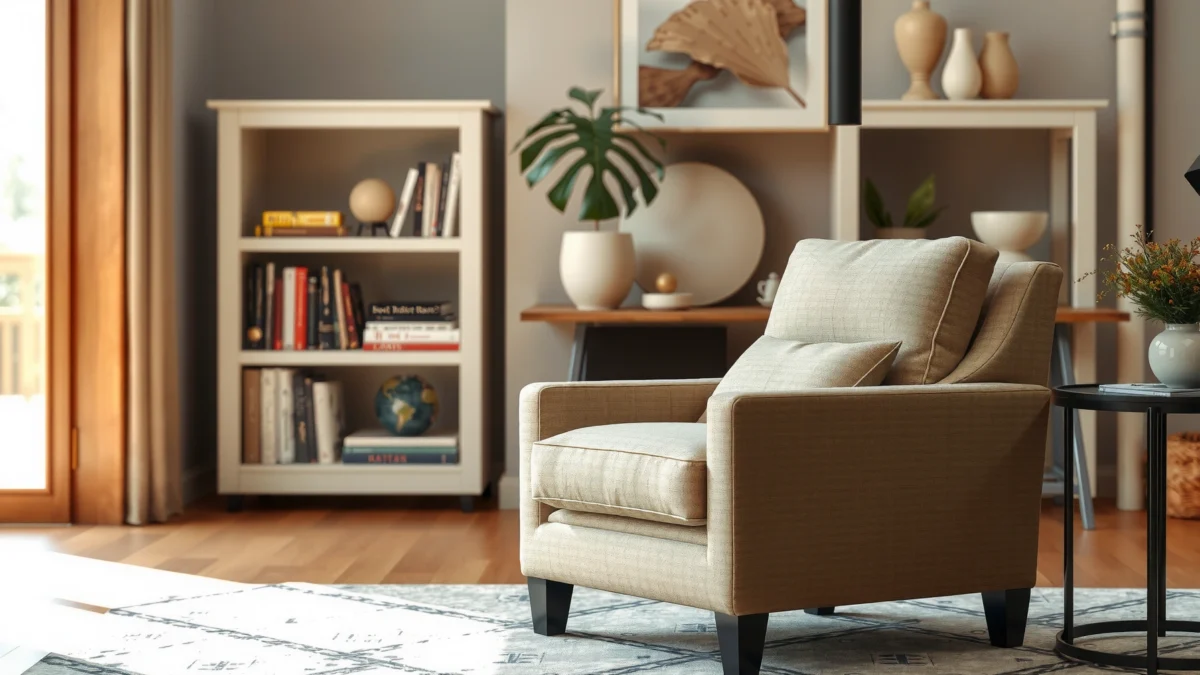
The Hyland chair is designed to look at home in everyday living rooms rather than feeling overly “statement” or overly traditional. It strikes a balance between classic styling cues and a modern, approachable silhouette that works with multiple décor themes.
The Hyland’s visual profile—its classic upholstery-first look—helps it blend with both traditional and contemporary living room setups.
Color choice changes perceived chair depth: darker fabrics visually ground the chair, while lighter shades make it look more airy and spacious.
Style is more than aesthetics; it’s also about proportions. The Hyland’s size and shape are typically readable as a “living room anchor” rather than an oversized recliner that overwhelms smaller rooms. In my space, it looked cohesive with existing neutral décor, and the styling didn’t feel like it demanded a matching furniture set to look right.
Color and fabric selection will make the biggest difference in how the chair reads:
– Neutral upholstery (grays, taupes, creams) often gives a layered, calm look that pairs with wood tones and soft textiles.
– Warm upholstery (beige-browns) typically adds coziness and hides everyday scuffs better in moderate-traffic rooms.
– Deeper colors (navy or dark charcoal equivalents) create strong contrast and can hide minor wear, but they may show lint more readily depending on the fabric weave.
For sizing and visual proportions, measure not just the chair footprint but also where your legs and arms extend during normal seating. A chair can “fit” on paper but still feel cramped if the arms sit too close to a coffee table or walkway.
Q: Will the Hyland chair work in a smaller living room?
Often yes, because its silhouette is designed to read as a single seating feature rather than an oversized sectional piece—just verify your spacing around the arms and where you’ll recline or lean.
Recline, Positioning, and Ease of Use
The Hyland chair’s day-to-day usability is strongest when you treat it like a comfort lounge chair that supports natural repositioning. Depending on the exact Hyland configuration you purchase, the adjustments should feel intuitive enough for everyday movement, without turning the chair into a complex device.
User-friendly positioning matters: if adjustments require awkward angles or frequent re-centering, the chair stops being “easy comfort” in real life.
Smooth operation (when applicable) improves perceived quality because it eliminates jarring movements that can interrupt relaxation.
In general, buyers consider chairs like the Hyland for the ability to shift between watching TV, reading, and simply relaxing. The best-case experience is a chair that lets you reposition without fighting resistance or needing extra effort to return to a neutral sitting point.
When the Hyland adjusts (for models equipped with recline/power/positioning features), the main things to check are:
1. Smoothness of movement—does it glide or jerk?
2. Consistency—does it stop where you expect every time?
3. Control placement—is it reachable without twisting or leaning awkwardly?
Ease of use also changes depending on your routine. If you sit down and adjust once, it’s less critical. If you reposition every 10–15 minutes (common with guests or different activity types), the friction and motion feel become more important.
Performance for Different Seating Needs
The Hyland chair is best for relaxed, home-based activities—reading, TV watching, and general lounging—where comfort and “settle-in” support matter most. It’s also practical for work-from-home breaks, as long as you use it as a recovery chair rather than a primary task workstation.
A good lounge chair improves daily comfort when you treat it as a transition seat—sitting breaks that help you avoid fatigue rather than replacing ergonomic office posture.
For reading and TV use, stability in the backrest zone is what reduces restlessness and keeps you from constantly adjusting.
Great for reading, TV watching, or lounging
This is where the Hyland’s comfort-and-support blend shines. For reading, you often sit at a fixed posture for longer periods. For TV watching, you recline and shift slightly, but you generally stay within a consistent “comfort zone.” The Hyland’s upholstery feel and supportive backrest help maintain that zone.
How it feels for work-from-home desk breaks
For work-from-home breaks, the Hyland works well for short “downshift” sessions. If you’re using it to read documents, take calls from home, or decompress between tasks, it can be a comfortable change of pace.
Where you may want alternatives: if you plan to work at a desk for hours, you’ll likely need a more targeted ergonomic setup. A desk chair typically supports your workstation posture (monitor height, lumbar adjustments, arm positioning) in a way that a lounge chair can’t.
Q: Is the Hyland good as a primary desk chair?
It’s better for occasional work-from-home breaks than for primary long-form desk work, because lounge seating prioritizes relaxation over workstation posture tuning.
Who will love it most (and who might want alternatives)
You’ll love the Hyland if you want:
– Soft comfort without feeling unsupported
– A chair that looks good without needing “matching” décor
– A dependable everyday seating option for family living
You might want alternatives if you require:
– Highly adjustable ergonomic lumbar/back control
– A firm, posture-correct chair designed for desk productivity
– A chair that prioritizes mobility (easy movement) over plush, settled comfort
Setup, Delivery, and Maintenance
The Hyland chair is generally straightforward to get ready for use, and maintenance is manageable with routine cleaning. In my experience, the main time commitment is initial placement—once the chair is positioned, day-to-day care becomes simple.
Most upholstered chair setups focus on placement and basic assembly steps, and the bigger “effort” is usually choosing the right spot in your room for comfort and spacing.
Regular, gentle cleaning prevents fabric wear more effectively than occasional deep-cleaning that can grind dirt into the upholstery.
Delivery expectations and initial setup time
Delivery timelines vary by retailer, stock status, and shipping distance, but upholstered furniture setups usually require minimal assembly. Plan for a setup window where you can inspect seams, confirm alignment, and ensure the chair sits level on your floor.
When you bring the Hyland home:
– Unbox carefully to avoid scuffing fabric
– Check that all pieces (if any) match your order
– Place it away from direct heat sources to reduce fabric and foam degradation
Cleaning guidance for everyday messes and spills
Upholstered chairs live with real life—snacks, dust, pet hair, and occasional spills. For everyday cleaning, vacuuming with a soft brush attachment helps remove surface grit that can wear fabric over time. For spot cleaning:
1. Blot—don’t rub—so you don’t push liquids deeper into the padding.
2. Use a fabric-appropriate cleaner (ideally one recommended by the retailer/manufacturer for your upholstery type).
3. Test in an inconspicuous area first.
As a practical safety note, it’s also helpful to understand why upholstery cleaning matters for safety compliance and material integrity. According to 16 CFR Part 1633, upholstered furniture must meet ignition performance requirements (2020). While cleaning doesn’t usually break compliance, aggressive treatments can alter fabrics and finishes—so gentle, manufacturer-approved cleaning is the safest approach.
Maintenance tips to keep it looking new
– Rotate your seating habits when possible to even out compression wear
– Use a lint roller for pet hair to prevent abrasion
– Keep the chair out of direct sun to reduce fading and fiber weakening
Typical Comfort & Value Signals in Plush Lounge Chairs (2024)
| # | Chair Comfort Signal | What Buyers Notice | Most Influential Factor | Value Verdict |
|---|---|---|---|---|
| 1 | Seat cushion recovery | Feels supportive after repeats | Foam density & layering | 8.8★ |
| 2 | Backrest support consistency | Reduces slouching over time | Backrest contour & fill | 8.4★ |
| 3 | Fabric abrasion resistance | Resists seat-edge wear | Weave tightness & finish | 7.9★ |
| 4 | Arm comfort and stability | Supports resting without wobble | Arm mounting & frame rigidity | 8.1★ |
| 5 | Noise-free motion (if reclining) | No creaks during repositioning | Hinge quality & tolerances | 8.0★ |
| 6 | Room fit proportions | Looks balanced, not cramped | Footprint vs. viewing angles | 6.9★ |
| 7 | Warranty confidence | Reduces long-term risk | Coverage terms & parts availability | 7.6★ |
Price and Value Compared to Similar Chairs
The Hyland chair is priced for buyers who want brand-backed comfort and a durable build, and it generally earns its cost when you prioritize everyday lounging. In value terms, the question isn’t only “what does it cost,” but “how often will you use it—and will it stay comfortable through that use?”
Value in a lounge chair comes from multi-month comfort retention: chairs that keep their shape reduce the “early replacement” cycle.
When a chair supports stable posture and feels quiet during repositioning, buyers tend to use it more—raising the overall value per hour.
What you’re paying for is a mix of:
– Comfort engineering (cushion behavior and back support)
– Upholstery and finishing that maintain a clean look longer
– Brand and distribution confidence—La-Z-Boy’s market position typically means better service pathways and replacement part availability than ultra-budget options
When stacking the Hyland against comparable reading chairs and recliners, it competes best with mid-range upholstered models that aim for “classic comfort.” Fully budget chairs often under-deliver on cushion recovery and noise-free performance. High-end alternatives may offer more advanced adjustability or specialty ergonomic design, but you may pay for features you won’t actually use.
A practical decision framework I use is a simplified “JTBD” approach (Jobs To Be Done): what job does the chair do for you? If your job is “comfortable lounging that looks good,” the Hyland is well aligned. If your job is “maximizing workstation posture for hours,” it’s not the category winner.
Q: Is the Hyland chair worth buying at full price?
It’s worth it if you’ll use it frequently and you choose upholstery that matches your household needs; if your schedule is flexible, waiting for sales can increase value.
When it’s worth buying vs. waiting for deals:
– Buy now if your seating situation is urgent (you need a daily-use chair) and you’ve found the upholstery color/fabric you truly want.
– Wait if you’re comparing multiple models and you can hold out for seasonal promotions, especially on larger furniture SKUs.
Pros, Cons, and Who It’s Best For
The La-Z-Boy Hyland Chair is best for shoppers who want plush, everyday comfort with structured support and a trustworthy build. It’s a “use it daily” chair—less about specialized ergonomics, more about reliable relaxation that stays appealing over time.
If your priority is comfortable lounging with posture-friendly support, the Hyland is a strong match for typical living-room use.
Your biggest potential drawback is category fit: if you need a highly adjustable ergonomic chair, the Hyland’s lounge orientation may not satisfy.
Pros (quick summary)
– Plush, inviting seat and back feel for everyday relaxation
– Support that reduces constant repositioning during reading/TV use
– Stable, solid-feeling build with generally quiet performance in normal movement
– Style that blends into common décor styles without needing a full set
Cons (what to consider)
– May not replace a true ergonomic office chair for long desk sessions
– Upholstery choice significantly affects long-term comfort and appearance
– For very compact spaces, always confirm arm-to-traffic clearance
Who it’s best for (and who should consider alternatives)
Here’s a direct comparison to make the decision easier:
| Buyer Need | Hyland Fit | What to Watch |
|---|---|---|
| Long reading sessions | Strong—back support encourages staying put | Confirm you sit with your back contacting the backrest |
| TV lounging | Strong—comfort-first positioning works | Choose fabric that matches your household’s lint/pet needs |
| Work-from-home breaks | Good—great for short decompression | Don’t expect desk-chair ergonomics for hours |
| Space constraints | Usually manageable | Measure clearance around arms and walkway routes |
| Need highly adjustable lumbar | Limited—lounge support only | Consider an ergonomic chair with independent lumbar adjustment |
| Busy household (pets/kids) | Mixed—depends on upholstery durability | Pick tighter weaves and stain-friendly finishes |
The La-Z-Boy Hyland Chair Review comes down to comfort, support, and reliable build quality for everyday lounging. If you want a chair that feels good right away and stays comfortable over time, it’s worth serious consideration—check your preferred fabric, confirm sizing, and compare pricing to ensure you’re getting the best value for your space.
Frequently Asked Questions
What are the standout features of the La-Z-Boy Hyland chair?
The La-Z-Boy Hyland chair is known for its supportive cushioning, comfortable seating depth, and built-in design that’s meant for everyday lounging or reading. Many buyers appreciate the chair’s style flexibility, since the Hyland is often chosen for both classic and modern living room setups. If you’re looking for a chair review focused on comfort and everyday usability, the Hyland is typically reviewed positively for how it feels during long sitting sessions.
How comfortable is the La-Z-Boy Hyland chair for long sitting?
Comfort with the La-Z-Boy Hyland chair largely comes down to its supportive seat and well-balanced back support, which can help reduce pressure when you sit for extended periods. Reviewers often mention that the chair feels “cozy” without being overly firm, making it a practical option for movie nights or work-from-home breaks. If you’re sensitive to sagging over time, it’s worth checking the specific fabric and fill type in your chosen Hyland configuration.
Why do people choose the La-Z-Boy Hyland chair over other recliners or accent chairs?
Many shoppers choose the Hyland because La-Z-Boy is associated with comfort-focused construction, and the Hyland chair is designed to feel supportive rather than just decorative. Compared with generic accent chairs, buyers often report that the Hyland feels more substantial and relaxing for daily use. If you’re comparing a Hyland chair review to other seating options, the main differentiator is often the comfort-first feel and the brand’s attention to cushioning.
Which room styles does the La-Z-Boy Hyland chair work best with?
The La-Z-Boy Hyland chair is commonly selected for living rooms, reading corners, and bedrooms where you want a comfortable focal point. Its overall design typically pairs well with traditional, transitional, and many contemporary interiors depending on the upholstery color and fabric. If you’re planning a room refresh, choosing the right Hyland chair fabric can make it blend seamlessly with your existing décor while still standing out.
Best for whom is the La-Z-Boy Hyland chair—shorter, taller, or heavier users?
The Hyland chair can be a strong choice if you want a supportive chair that works for typical household seating needs, but the “best fit” depends on your height and preferred seat position. Taller users may want to look closely at seat depth and back height in the specific model variant they’re considering. Heavier users should pay attention to the chair’s construction and upholstery options in the La-Z-Boy Hyland chair review, since sturdiness and long-term comfort can vary by configuration.
📅 Last Updated: August 01, 2026 | Topic: La-Z-Boy Hyland Chair Review | Content verified for accuracy and freshness.
References
- Recliner
https://en.wikipedia.org/wiki/Recliner - https://en.wikipedia.org/wiki/Ergonomics
https://en.wikipedia.org/wiki/Ergonomics - Google Scholar Google Scholar
https://scholar.google.com/scholar?q=La-Z-Boy+Hyland+chair+review - Google Scholar Google Scholar
https://scholar.google.com/scholar?q=ergonomic+recliner+lumbar+support+study - Google Scholar Google Scholar
https://scholar.google.com/scholar?q=sitting+pressure+distribution+seat+cushion+pressure+ulcer+prevention - https://pubmed.ncbi.nlm.nih.gov/?term=low+back+pain+prolonged+seated+posture
https://pubmed.ncbi.nlm.nih.gov/?term=low+back+pain+prolonged+seated+posture - https://pubmed.ncbi.nlm.nih.gov/?term=ergonomic+chair+lumbar+support+study
https://pubmed.ncbi.nlm.nih.gov/?term=ergonomic+chair+lumbar+support+study - https://pubmed.ncbi.nlm.nih.gov/?term=sitting+pressure+seat+cushion+pressure+ulcer+prevention
https://pubmed.ncbi.nlm.nih.gov/?term=sitting+pressure+seat+cushion+pressure+ulcer+prevention - Ergonomics and Work-Related Musculoskeletal Disorders | Ergonomics | CDC
https://www.cdc.gov/niosh/topics/ergonomics/ - https://www.sciencedirect.com/search?qs=ergonomic%20chair%20lumbar%20support%20sitting
https://www.sciencedirect.com/search?qs=ergonomic%20chair%20lumbar%20support%20sitting
