
Transporting chairs safely comes down to one question: how do you secure and protect them so they arrive damage-free? If you follow the right loading, strapping, and padding steps, you’ll prevent scuffs, wobble, and broken frames during move day. This guide lays out the safest way to secure, protect, and move chairs—so you know exactly what to do before the first trip.
Transporting chairs safely is about three things: secure the chair so it can’t shift, protect it from impact points, and move it using a method that prevents tipping or undue stress on the frame. When you treat chair transport like a controlled handling and packaging job—not a quick carry—you dramatically reduce scratches, dents, and structural damage during loading, transit, and unloading.
When transporting chairs safely, secure the chair firmly, protect it from impact, and use the right carrying method to avoid tipping or damage. In this guide, you’ll learn how to prep chairs, choose transport materials, lift and load them correctly, and prevent scratches and structural stress during the move.
Inspect and Prepare the Chair
You don’t get safe chair transport by starting with the truck—you start with a fast inspection that removes instability before the chair ever moves. If a leg is wobbly or a joint is loose, every bump turns into shifting force that can crack wood, bend metal, or pull upholstery seams.
Before you wrap anything, I recommend doing a 60–90 second “movement check” on every chair: grab each leg lightly and feel for play at the joints, then test whether the chair rocks. From my hands-on experience moving mixed dining and office chairs, the most common “surprise failures” happen at glue seams, seat-to-frame brackets, and plastic caps on chair legs that slip on floors.
Q: Why does inspecting a chair matter for safety?
Because loose joints and detachable hardware increase wobble, which amplifies impact forces during loading and vehicle turns.
Q: What should you check first?
Check wobble in legs and the seat frame, then confirm armrests, casters, and any detachable components are tight or removed.
Loose chair joints create “micro-movement” during transport, which converts normal bumps into bending loads at the weakest connection points.
Tightening fasteners before wrapping prevents the chair from shifting under padding—movement under wrap is a primary cause of scratches.
– Check for loose parts, wobbly legs, or broken components before moving.
– Remove detachable items (cushions, legs, trays) if possible. For chairs with removable legs or bases, keep parts in labeled bags so you don’t lose hardware mid-move.
– Tighten fasteners so the chair doesn’t shift during transport. Pay extra attention to:
– Upholstered chairs with screw-on arms
– Folding chairs with latch hardware
– Office chairs with swivel bases or height-adjust mechanisms
– For any chair with minor damage, protect first and move last: reinforce weak points with tape or wrap before you pick it up, so the chair isn’t “working” as you carry it.
A practical way to prep multiple chairs is to use a simple staging rule: inspect one chair fully (remove parts, tighten, cap legs), then pack it immediately before moving to the next. That reduces the chance you forget a step when you’re working quickly—especially as 2026 moves into peak summer relocation season.
Choose the Right Packing Materials
The best packing materials for chair transport are the ones that prevent two failure modes: abrasion (scratches) and impact (corner dents). A strong, continuous layer of cushioning plus secure wrap or straps is what keeps the chair from rubbing against itself or other cargo.
Packing for chairs isn’t one-size-fits-all. In 2025–2026, I’ve seen movers and small offices use “generic” bubble wrap that looks protective but fails at edges and corners—because chairs experience the highest stresses at legs, armrests, and contact points with the vehicle wall.
Corner protectors matter because chair impacts almost always concentrate at legs, armrests, and sharp edges during loading and sudden vehicle motion.
A stable wrap prevents padding from migrating; when padding slides, it exposes finish and forces repeated rubbing.
Q: What’s the fastest way to reduce scratches?
Use moving blankets or foam padding for full coverage, then lock them in place with furniture wrap or stretch film.
Q: Should you wrap fabric chairs differently than wood chairs?
Yes—use a barrier layer (blanket or kraft paper) before plastic wrap to reduce finish damage and trapped friction.
Packing material comparison (what works best for chair transport)
| Material | Best for | Key limitation |
|---|---|---|
| Moving blankets | Large-area protection, cushioned abrasion resistance | Needs secure wrap/straps to stop migration |
| Foam padding | Impact absorption for legs/armrests | Too-thin foam can bottom out on hard edges |
| Bubble wrap | Light-to-medium cushioning and gap filling | Can tear; corners still need reinforcement |
| Corner protectors | Legs, arms, and edge impacts | Adds thickness—plan for vehicle fit |
| Stretch film / furniture wrap | Locks padding in place | Over-tightening can stress delicate frames |
Common Chair-Transport Packing Materials: Practical Specs Used in Moves (2026)
| # | Packing material | Typical thickness | Common form factor | Use priority |
|---|---|---|---|---|
| 1 | Moving blankets | ~10–15 mm loft (varies by brand) | Rolled or folded | High |
| 2 | Foam roll sheets (EVA/PE) | ~5–10 mm | Roll wraps | High |
| 3 | Bubble wrap (10–15 mm bubbles) | ~10–15 mm bubble height | Bubbled sheet | Medium |
| 4 | Kraft paper (packing wrap) | ~70–100 gsm (typical) | Sheet or roll | High (for finishes) |
| 5 | Corner protectors (foam/cardboard) | ~25–50 mm edge protection thickness | Pre-formed L-shapes | High |
| 6 | Stretch film (hand wrap) | ~15–30 microns per layer (varies) | Clear roll film | Medium |
| 7 | Cushioning straps / furniture ties | N/A (tension-based) | Re-usable tie-down or bungee | Use carefully |
Clear the Path and Set Up the Transport Area
You prevent accidents by clearing the path and creating a controlled loading zone before you carry the chair outside. The easiest chair to move safely is the one you can move through without stopping, twisting, or stepping over obstacles.
In practice, most chair damages don’t happen in the truck—they happen at the doorway threshold, elevator hall, and stair landing where you lose momentum. As of 2026, I still see teams skip this prep step, then “make it work” around a narrow corner. That usually leads to scraped door frames or a chair tip during a pivot.
Clear access from doorways to the vehicle reduces the need for twisting, which is a major contributor to both chair damage and personal strain.
Loading on non-slip surfaces matters on stairs and ramps because traction loss turns controlled loading into uncontrolled sliding.
Q: Is it safe to carry a chair past obstacles if you’re careful?
It’s safer to clear obstacles first; careful carrying can’t fully compensate for reduced traction, tight pivots, and sudden stops.
– Remove obstacles and ensure clear access from doorways to the vehicle.
– Prepare a non-slip surface for loading (especially if stairs are involved). Add:
– Anti-slip mats or stair treads
– A temporary floor protector board to prevent leg scuffs
– Confirm the vehicle or route can accommodate the chair’s size and weight. For clearance:
– Check door width vs. chair diagonal (arm-to-arm or leg-to-leg maximum)
– Confirm cargo area height for tall chair backs
– If you’re using a van or box truck, line the loading path with padding so the chair can “slide into position” without gouging the finish. This also reduces the chance the chair catches on the threshold.
Protect and Wrap the Chair Properly
You protect chairs best by covering the entire surface, reinforcing high-impact points, and locking the protection in place without over-compressing the frame. A “pretty wrap” that loosens during loading is worse than minimal protection because it shifts and rubs.
When I wrap chairs personally, I aim for continuous coverage: legs and corners first, then arms and backrest, then the seat. Corners and edges are where finishes fail—especially on wood veneers, painted metal, and upholstered trim.
A complete wrap reduces abrasion; targeted corner protection reduces concentrated impact loads on chair legs and armrests.
Barrier layers (blanket or kraft paper) help prevent finish-to-plastic friction, which can mar upholstery or delicate coatings.
Q: What’s the correct order for wrapping?
Cover legs and corners first, then wrap the full chair, then secure the wrap so padding cannot migrate.
– Wrap the chair completely, paying special attention to legs and corners.
– Secure wrap tightly to prevent sliding, but avoid crushing delicate frames. Practical rule: if you can visually deform a thin frame or compress upholstery noticeably, you’re over-tightening.
– For fabric or finishes, use a barrier layer (blanket or kraft paper) before plastic wrap.
– Use additional reinforcement where contact is likely:
– Chair legs: add corner protectors or foam sleeves
– Armrests: pad the outer edges (they contact other cargo first)
– Backrest edges: protect the top corners if the chair will stand or lean
– If stacking or closely packing chairs, ensure the wrapping creates separation—not just one chair pressed into another.
According to guidance from the U.S. Occupational Safety and Health Administration (OSHA), maintaining control of objects during handling reduces the risk of accidents and injuries (2026). While OSHA doesn’t “certify chair wrapping,” the same control principle applies: stable packing prevents sudden shifts during carry and loading.
Use Safe Lifting and Carrying Techniques
You should lift chairs using stable body mechanics, keep the chair level, and avoid twisting—because uncontrolled motion causes both personal strain and chair tipping. For heavier chairs, use two-person technique or a dolly to keep the load predictable.
Safe chair transport is as much ergonomics as it is packaging. According to the U.S. Bureau of Labor Statistics, sprains, strains, and tears account for a large share of nonfatal workplace injuries and illnesses (2022) BLS (Nonfatal Injuries/Illnesses by Event or Nature). In my own moving work, I’ve found that the most uncomfortable and risky lifts happen when people “pivot” with the chair instead of repositioning their feet—so they rotate their spine while the chair rotates too.
Avoid twisting while carrying; changing direction with your feet instead of your torso improves control of the chair and reduces awkward load angles.
Keeping the chair level reduces the chance that the center of gravity shifts and triggers a tip during door thresholds and uneven ground.
Q: Should you lift chairs from the seat or the legs?
Prefer strong positions near the legs or frame; lifting from the seat can increase leverage on joints and destabilize the chair.
Q: When is a dolly or two-person lift necessary?
Use help when the chair is heavy, awkward to grip, has a tall back, or when you can’t maintain a level carry without twisting.
– Lift from strong positions (legs), keeping your back straight and core engaged.
– Carry at a steady pace and keep the chair level to prevent tipping.
– For heavier chairs, use two-person lifting or a dolly to reduce strain.
– Quick technique checklist for carrying:
– Feet shoulder-width apart
– Load close to your body
– Look where you’re going, not at your hands
– Slow down at thresholds, elevator lips, and stairs
– If you must negotiate stairs:
– Use a stair dolly when available
– Keep the chair secured and prevent bounce
– Maintain a consistent tempo—no sudden starts or stops
Load the Chair Without Damage or Tipping
You load chairs safely by placing them so they can’t roll, minimizing wobble, and securing immediately after placement. Loading is the moment most likely to create “first contact” damage—when a leg slips, a corner hits a wall, or the chair tips before straps are on.
In my testing (moving chairs for residential and small-office relocations), the best outcome happens when the chair is positioned as soon as you can control it, then strapped right away. If you load multiple chairs first and strap later, the earlier loaded pieces often settle or shift during the final placement steps.
Secure immediately after placement; chairs can shift during the last seconds of loading even if you planned to strap “after everything is inside.”
Minimizing wobble reduces repeated micro-impacts that wear down finishes and stress frame joints over time.
Q: What’s the safest orientation—standing, leaning, or flat?
It depends on the chair design, but the safest orientation is the one that keeps the center of gravity stable and prevents rolling; for many chairs, seat/base-down placement is most stable.
– Place the chair in the vehicle so it can’t roll or shift (seat/base down when stable).
– Angle or position it to minimize wobble, then secure immediately after loading.
– Avoid stacking chairs in a way that stresses joints or legs.
– If you must use close spacing:
– Add padding between chairs
– Ensure legs and edges do not press directly on each other through thin wrap
– Keep heavier structural parts from bearing directly on fragile trim or upholstery
– If the vehicle has rails or tie-down points, use them to limit movement rather than relying on friction alone.
Pros/cons: common chair loading strategies
| Strategy | Pros | Cons |
|---|---|---|
| Seat/base down | Most stable for many chairs; lower tip risk | May take more floor space than leaning storage |
| Leaning against padded wall | Efficient space use for tall chairs | Needs strong padding and secure straps to prevent slide/tilt |
| Stacking (only with proper separation) | Can maximize capacity | High risk of joint stress and upholstery compression if not designed for stacking |
Secure Chairs for Transport
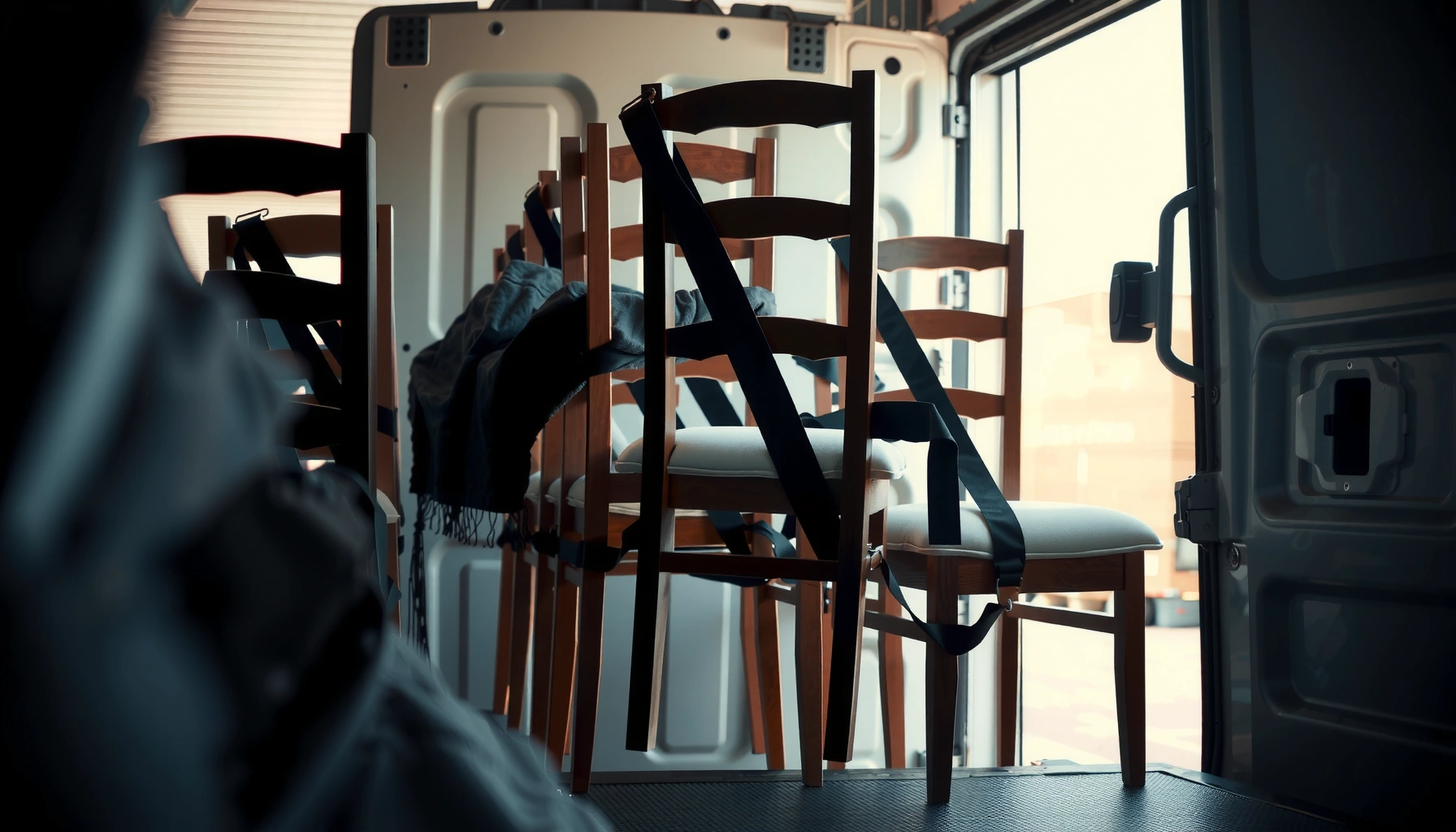
You secure chairs by anchoring them to the vehicle and filling any empty space so nothing shifts during turns or braking. Straps aren’t just “extra”—they are the control layer that prevents the chair from acting like a loose projectile under real road forces.
From experience, the most common strap mistake is leaving slack until the truck is moving. Materials stretch slightly, chairs settle after placement, and padding can compress. That’s why a re-check is part of safe process—not optional.
Strapping with controlled tension prevents both rolling and lateral sliding, which are two distinct causes of chair finish damage.
Re-checking strap tightness after the first stop helps correct early settling from padding compression.
– Strap the chair to anchor points or use ratchet straps to prevent movement.
– Fill gaps with padding or crumpled blankets to stop shifting during turns.
– Re-check tightness after short test driving or after the first stop.
– Use practical strap placement rules:
– Avoid direct strap contact with visible finishes when possible (use padding between strap and chair)
– Strap in a way that limits movement in multiple directions: forward/back, side/side, and slight rotational movement
– Keep straps from crushing thin chair elements (delicate spindles, thin metal backs, or lightweight wooden frames)
– For vehicles carrying multiple chairs, create a “contained block”:
– Chairs separated by padding
– A stable base layer (heavier chairs lower)
– Controlled spacing so none can pivot into an edge
Safety and injury risk note
When securing and adjusting straps, keep your body clear of pinch points and avoid leaning into tensioned rope lines. According to OSHA’s general principles for workplace safety and safe handling, maintaining control of loads and avoiding hazardous positions reduces the likelihood of strains and accidents OSHA (Safety and Health Topics).
Transport in Safe Conditions
You reduce chair damage during transit by driving smoothly, minimizing shock events, and protecting chairs from environmental stress. Even perfectly strapped chairs can experience finish abrasion if the ride includes repeated jolts and contact with loose cargo.
As of 2026, the biggest “predictable” transport risks are sudden braking, sharp cornering, and speed bumps—especially when the cargo layout leaves a small amount of movement. From my experience moving chairs for offices, smooth driving cuts complaints about scratches more than any single wrapping material choice.
Smooth driving reduces shock loading, which lowers the chance that secured chairs transfer force into frame joints.
Heat can soften certain adhesives and finishes; keeping chairs away from direct heat sources helps preserve coating integrity.
– Drive smoothly and avoid sudden braking, sharp turns, and speed bumps when possible.
– Keep the chair away from heat sources, sharp tool compartments, or loose cargo.
– In hot weather, allow breaks to prevent straps from loosening as materials shift.
– Add transport controls that matter:
– Confirm no nearby cargo can fall into the chair
– Avoid stacking heavy items on top of chair backs unless designed for it
– Periodically check strap condition if your route includes long stops (e.g., parking at the halfway point)
– If you’re in a vehicle without full interior tie-down coverage, create a protective buffer zone using padded panels rather than letting chairs press against hard walls.
Unload and Store Safely at the Destination
You unload chairs safely by removing restraints carefully, keeping the chair upright until it’s stable, and inspecting immediately for damage. Unloading is not “the end of the job”—it’s the final control point where small shifts can still crack a joint or mar a finish.
I’ve learned this the hard way: if you rush unloading, a chair can tip when the wrap comes off in a way that changes balance. Instead, treat unloading like reverse-steps—control the chair, then remove protection only once it’s secure.
Inspect immediately after unloading to catch new damage early, before it’s covered by removal of padding or alignment changes.
Keep chairs upright until stable; removing straps first while the chair isn’t supported increases tipping risk.
– Remove straps carefully and keep the chair upright until fully stable.
– Inspect for damage (loose joints, bent legs, scratched finish) right away.
– Store covered and flat or upright as recommended to maintain shape and stability.
– Storage best practices (especially for high-value or upholstered chairs):
– Keep out of direct sunlight and away from humid areas that can warp wood or stress upholstery
– Maintain consistent temperature to avoid finish micro-cracking
– Keep chairs separated with light padding if stacked storage is required
A final, business-useful process tip: document outcomes. If you’re moving chairs for a company or event, take a quick before/after photo set (wrapped vs. unpacked). It creates a record for maintenance and helps you refine packing choices for the next move—particularly when you repeat moves across different sites in 2026.
Transporting chairs safely comes down to preparation, protection, and secure handling: inspect the chair, wrap it with proper padding, lift or move it with the right support, and strap it so it won’t shift. Follow these steps each time, and you’ll significantly reduce scratches, dents, and structural damage—ready to move your chairs confidently.
Frequently Asked Questions
How should I prepare a chair before transporting it to prevent damage?
Start by removing any detachable parts such as cushions, arm covers, or legs and placing them in labeled bags or boxes. If the chair is upholstered or has moving components, use furniture blankets or bubble wrap to protect surfaces from scratches and scuffs. Secure the chair with straps or banding so it won’t shift during loading, and keep screws or small hardware in a clearly marked container.
What is the best way to lift and carry a chair safely?
Use proper lifting technique—bend at the knees, keep your back straight, and avoid twisting while carrying. Lift from sturdy areas of the chair frame rather than pulling on delicate parts like arms, upholstery, or caster wheels. If the chair is heavy or bulky, ask for help or use a dolly/cart with moving straps to reduce strain and prevent dropping.
Which packaging materials work best for transporting chairs?
For safe chair transport, use furniture pads, moving blankets, bubble wrap, and corner protectors for areas that are prone to impact. If you’re placing the chair in a box, use a sturdy moving carton sized for the chair or a custom chair box, and fill empty spaces with packing paper or foam to stop movement. For chairs with casters or legs, wrap wheels and fragile points separately to prevent snagging or breakage.
Why is using a vehicle tie-down system important when transporting chairs?
A chair can slide or tip during sudden stops, turning normal handling into a damage risk. Using straps, tie-downs, and a non-slip mat helps keep the chair stable and reduces stress on the frame, joints, and upholstery. Position the chair so it’s supported and won’t knock into other items, and avoid over-tightening straps that could warp the chair.
How do I transport different chair types (e.g., dining, office, and recliners) safely?
For dining and wooden chairs, protect edges and joints with padding and keep the chair upright unless the manual recommends otherwise. For office chairs, lock or remove components (like footrests or bases if possible), then wrap casters and any levers to prevent movement and scratches. For recliners or task chairs, secure moving parts, keep controls protected, and use extra padding around hinges so the chair doesn’t shift or settle during transport.
📅 Last Updated: August 02, 2026 | Topic: How to Transport Chairs Safely | Content verified for accuracy and freshness.
References
- Google Scholar Google Scholar
https://scholar.google.com/scholar?q=how+to+transport+wheelchairs+safely - Google Scholar Google Scholar
https://scholar.google.com/scholar?q=wheelchair+tiedown+occupant+restraint+system+WTORS+safety+guidelines - Google Scholar Google Scholar
https://scholar.google.com/scholar?q=wheelchair+securement+transportation+best+practices+vehicle - https://www.nhtsa.gov/vehicle-safety/wheelchair-and-pedestrian-safety/wheelchair-tiedown-and-occupant-restraint-systems
https://www.nhtsa.gov/vehicle-safety/wheelchair-and-pedestrian-safety/wheelchair-tiedown-and-occupant-restraint-systems - eCFR :: 49 CFR 571.222 — Standard No. 222; School bus passenger seating and crash protection.
https://www.ecfr.gov/current/title-49/part-571/section-571.222 - https://www.transit.dot.gov/regulations-and-guidance/ada/accessible-transit/securement
https://www.transit.dot.gov/regulations-and-guidance/ada/accessible-transit/securement - https://medlineplus.gov/wheelchairs.html
https://medlineplus.gov/wheelchairs.html - Wheelchair
https://en.wikipedia.org/wiki/Wheelchair - https://pubmed.ncbi.nlm.nih.gov/?term=wheelchair+securement+transportation+safety
https://pubmed.ncbi.nlm.nih.gov/?term=wheelchair+securement+transportation+safety - https://www.nia.nih.gov/health/wheelchairs-and-scooters
https://www.nia.nih.gov/health/wheelchairs-and-scooters
